Showing posts with label suspensions. Show all posts

Thursday, May 6, 2021

The Athletic Hockey Show: Fight night at MSG

On this week's episode of The Athletic Hockey Show:
- Ian and I react to a gong show at the Garden
- James Dolan shocks the hockey world, twice
- Do we buy that that statement and those firings were unrelated
- How we would fix the Department of Player Safety
- Jesse joins us to talk Stanley Cup value bets
- This week in history, listener mail and lots more...

The Athletic Hockey Show runs most days of the week during the season, with Ian and I hosting every Thursday. There are two versions of each episode available:
- An ad-free version for subscribers that you can find here
- An ad-supported version you can get for free wherever you normally find your podcasts (like Apple or Spotify)


Wednesday, March 10, 2021

Puck Soup: ESPN, Tom Wilson, Darryl Sutter and more

On this week's episode of the Puck Soup podcast:
- The NHL returns to ESPN
- Why the last TV deal was a disaster, and why it's not (completely) Gary Bettman's fault
- A long argument about the Tom Wilson suspension
- Thoughts on Darryl Sutter resurfacing in Calgary
- The league reportedly wants to tweak the lottery rules
- OUFL on NHL team logos
- And more...

>> Stream it now:

>> Or, listen on The Athletic or subscribe on iTunes.

>> Get weekly mailbags and special bonus episodes by supporting Puck Soup on Patreon for $5.


Wednesday, December 4, 2019

A guide to some things you might expect to find in an NHL rulebook (but won’t)

I’ve always been a bit of a rulebook nerd. My readers know that, and we’ve had some fun with it over the years. Last season, we went through seven rules that don’t work the way you think, or that you might not have known were in the book at all. Did you know that it’s an automatic penalty to swear, or challenge a referee’s judgment, or (sometimes) even freeze the puck after a save? The NHL rulebook is weird.

But while there are lots of rules that you might not have known were in there, the flip side is also true. There’s stuff that hockey fans tend to assume is explained in detail in the rulebook, but isn’t. Sometimes it’s missing completely. In other cases, it’s a lot more vague than you might have been led to believe. Sometimes, that might even be a good thing.

Today, let’s dig into that side of the story, with five things you might assume you could find in an NHL rulebook that aren’t actually there.


Pretty much any definition of charging

What you know: Charging is a penalty that isn’t called often, but it comes up from time to time, and plenty of fans seem to believe that it should be called a lot more than it is. Leaving your feet to make a hit is definitely charging. So is skating halfway across the ice to drill a guy. You’ll sometimes hear that it’s based on how many strides a player takes before initiating contact.

It’s a bit of a gray area, sure, but you know it when you see it. (Specifically, you know it’s charging when you see a player from your favorite team get sent flying.)

What you might expect to find in the rulebook: Some sort of definition of what charging actually is.

What you get instead: An almost comically ambiguous description of charging that could be applied to half the hits in a typical game, or none of them at all.

Seriously, go check out Rule 42. It’s one of the shortest rules in the rulebook, just over 300 words; half of those are the standard-issue breakdown of minor versus major versus match, and half of what’s left is just a reminder that goalies aren’t fair game for hits. The actual description of charging is just two sentences long, and neither is very helpful.

The first tells us that a charging penalty “shall be imposed on a player who skates or jumps into, or charges an opponent in any manner.” The first problem here is that we’re using the word “charges” to help define what “charging” is, a turn of phrase that sounds like it should be read by Smokin’ Joe Frazier. But more importantly: any manner? That seems a little vague, no? It can be read as saying that skating into an opponent is always against the rules. Is every hit a potential charge?

Well, yeah, as it turns out, it kind of is. The next line clarifies, but only a little: “Charging shall mean the actions of a player who, as a result of distance traveled, shall violently check an opponent in any manner.” Now we know that we’re looking for violent checks, and that distance traveled is an important factor. But that’s as far as we go. Despite what you may have heard, there’s nothing in the rulebook about how many strides a player can take. And while there is that reference to jumping into an opponent, it doesn’t explicitly say that leaving your feet is an automatic charge, at least any more than skating into someone should be.

How it gets called: This is one of those rules that’s evolved as the game has changed. It’s a bit of a relic from the sport’s early days when players taking two-minute shifts would glide around the ice and only accelerate to full gear when needed. Back then, somebody going full speed into a body check would stand out – that was charging. But as Ken Dryden once told me, these days the entire game is played at charging speed. Based on how the sport works today and how the rule is written, it’s not an exaggeration to say that yes, literally every hit could be called charging.

Nobody wants that. Instead, today’s officials have pretty much settled on looking for a player who takes multiple strides into a stationary opponent and/or leaves his feet when delivering a hit. That’s reasonable. It’s just not what the rulebook says.

(Now can we also talk about how the phrase “leaves his feet” doesn’t make any sense?)

A clear-cut definition of possessing or controlling the puck

What you know: Certain scenarios covered in the rules will hinge on who has possession and/or control of the puck. Delayed penalty calls, legal line changes, penalty shots and offside calls can all depend on whether or not a player (or team) had the puck, and when.

What you might expect to find in the rulebook: A detailed definition of what it means to possess or control the puck.

What you get instead: Not much. Or, depending on how you look at it, maybe too much. References to possession show up all over the rulebook. Often, they’re accompanied by a reference to control, which is a similar concept but not the same thing. (As the rulebook charmingly puts it at one point, “A player can have possession of the puck without control, but he cannot have control of the puck without possession.” That’s almost deep enough to go on a motivational poster.)

Some of those references tip-toe up to defining the term, if very loosely. For example, Rule 56 on interference says that possession is simply “The last player to touch the puck.” But the closest we get to something firm is tucked away in the glossary, which says that control is “The act of propelling the puck with the stick, hand or feet.” That’s a start. But there’s nothing about, for example, the puck staying within a certain distance of the player, or how much contact he needs to make to maintain possession, or whether the propelling needs to be intentional, or any of the other nit-picky things you might wonder about.

You know how the NFL seems to have roughly six dozen rules and sub-rules about whether or not a receiver possessed the ball at a given moment? The NHL doesn’t have that. This might not be a bad thing.

How it gets called: This is another one that often falls into the “we know it when we see it” category. And honestly, that usually works out fine. Except when it doesn’t.

This came up recently in a game between the Bruins and Canadiens, where Charlie Coyle was ruled offside after video review on a play where he seemed to control the puck with his skates. The rulebook is clear that “a player actually controlling the puck who shall cross the line ahead of the puck shall not be considered offside.” But since it doesn’t really define what “actually controlling the puck” means, the officials were left on their own to figure out if Coyle’s skate skills were enough. They decided they weren’t. Lots of us watching disagreed, but the officials weren’t wrong, so much as they were caught in a gray area of the rulebook.

>> Read the full post at The Athletic

(Want to read this post on The Athletic for free? Sign up for a free seven-day trial.)


Thursday, October 13, 2016

The faker's guide to being an NHL fan

The NHL regular season has finally arrived, and you know what that means: Everywhere you go, all anyone wants to talk about hockey! (If you're in Canada, "everyone" is everyone. If you're in the United States, "everyone" is that one really polite guy at work who talks kind of slow and might secretly be Canadian.)

But what if you're not a hockey fan? You could become one, but that sounds like work. No, what you want is to be able to plausibly fake it. So today, I'm going to walk you through the five key skills you'll need to pretend to be a hockey fan even though you're not.

Skill #1: Blame Gary Bettman for everything

Bettman has been NHL commissioner since 1993, and everything bad that has ever happened is his fault. I don't mean everything bad in the NHL since 1993—literally everything bad is a direct result of Bettman's existence. The 2004 lockout that wiped out an entire season? Bettman. The loser point? Bettman. That time in 1988 when two guys in raincoats ended up officiating a playoff game? Bettman. The routing of the French nobles at the Battle of Courtrai? Partly the marshy terrain and strategic positional advantage of the Flemish forces, but mostly Bettman.

I really can't stress this point enough: If you're going to fake your way through hockey fandom, complaining about Gary Bettman is the single most important skill you can learn. Get really good at it, and you might even get a job in the hockey media.

If you're ever involved in a conversation about hockey that you're not really following and it suddenly gets quiet and everyone looks at you like it's your turn to speak, just shake your head grimly and mutter "fucking Bettman." Then get ready for a round of high-fives.

>> Read the full post at Vice


Monday, May 16, 2016

Weekend Report: Ovechkin, Crosby, and a missed opportunity for the DOPS

Heading into Friday night's opening game between the Lighting and Penguins, here are a few of the things we were pretty sure we knew. Pittsburgh were the favorites, not just to win the series but, according to oddsmakers, to win the Stanley Cup. Matt Murray was firmly established as the starter. With Anton Stralman and Steven Stamkos reportedly nearing returns, the two teams were remarkably healthy for a third-round series. And with little history to draw on, there wasn't much in the way of bad blood.

By the time the final horn sounded, all of that was out of the window, thanks to a bizarre Game 1 that was punctuated by several questionable hits and apparent injuries. That included Ryan Callahan's dangerous hit from behind on Kris Letang, one that drove the Penguin defenseman's head into the glass and left him lying on the ice.

Callahan was given five minutes (but oddly, not ejected), and Letang eventually returned. Later in the game, Chris Kunitz went knee-on-knee with Tyler Johnson, and Ondrej Palat hit Brian Dumoulin from behind.

Despite all that, the game's most serious injury appeared to come on a harmless looking play. Lightning goalie Ben Bishop twisted his knee on his way back to the crease and went down in agony; he was eventually stretchered off of the ice.

By the time we went to sleep on Friday night, we figured that Bishop would be out for a while and Callahan would be suspended. By Saturday, we found out the Bishop was merely day-to-day and Callahan had been given the all-clear by the department of player safety. It was as if even the writers decided they'd gone a bit overboard on the pilot episode, and retconned a few of the weirder plot points out of existence in hopes we wouldn't notice.

(Oh, and the Lightning won the game, 3-1. It was easy to forget that detail with everything else that was going on, but it's possible that it turns out to be important.)

Thankfully, last night's Blues/Sharks opener was polite enough to mostly follow expectations. The two teams played a close game, one that was ultimately won by the Blues by a 2-1 final but could have gone either way, with the Sharks coming close to tying the game in the dying minutes.

It was a classic playoff contest between two relatively evenly matched teams. And more importantly, after Friday's chaos, it didn't feature anything especially weird, beyond an unfortunate early whistle that could have cost the Sharks the tying goal. Sure, Ken Hitchcock's awful decision to challenge an obvious goalie interference call early in the first was a little odd, but it didn't end up mattering. If that had happened during the Penguins/Lightning game, it would have guaranteed at least three disputed offside goals in the third period, and somebody would have speared the referee in the groin during the review.

So thank you, Blues and Sharks, for sticking to the script. We look forward to seeing what madness you're no doubt saving up for later in the series.

Top Five

Celebrating those who've had the best week.

5. Colin Wilson—He's out now, eliminated along with the rest of the Predators in Game 7. But let's take a moment to recognize Wilson's 13 points in 14 games, a total that made him this year's official "Guy who gets picked in the last round of the office playoff pool and screws up the standings for everyone." Way to go, Colin!

4. The schedule—Typically, this is the time of year when the schedule goes off the rails. With just four teams left, the combined pressures of TV partners, arena availability and the league's weird insistence on just taking a few random days off every now and then means we get a schedule with lots of gaps and inconsistency.

But somehow, they got it right this year. Not perfect—the lack of a Saturday game over the weekend was disappointing. But from here on out, the schedule is pretty much ideal. There's a game every night, with the two conferences alternating days the rest of the way. No weird gaps, and no back-to-back games that everyone will complain about. Just a game every second night in both series, the way the hockey gods intended. And the NHL didn't even make us wait around for things to get started, with the Eastern final kicking off the day after the second round wrapped up.

The NHL has finally figured out how to schedule the playoffs. Either that, or its getting ready to really screw things up during the Stanley Cup final and is just getting us to let our guard down. Either way, we should enjoy it while we can.

>> Read the full post at Vice Sports


Tuesday, May 10, 2016

The 12 controversies you meet in every postseason

The 2016 NHL playoffs have been nothing if not controversial. We’ve had blown calls, suspensions, non-suspensions and bad blood. There have been unfortunate soundbites and inappropriate gestures. And everyone from the players to the fans to the media have been involved.

If all of this sounds familiar, it should. We go through this same list every year. The NHL playoffs are a breeding ground for controversy, thanks to high emotions, an ever intensifying spotlight and razor-thin margins separating victory from defeat. On any given night, you can count on something happening somewhere that will have fans at each other’s throats. And there’s plenty more to come. After all, we’re only halfway through this year’s playoffs.

So this seems like a good time to regroup and remind ourselves that we’ve been here before and we’ll be here again. Here are the dozen controversies you’re likely to meet in any given post-season, including this one, and a refresher on how best to handle them.

The Crucial Missed Call

What happens: The play itself isn't flagrantly dirty – we'll get to those ones down below. But it's clearly a penalty, one you've seen called virtually every other time it happens. But this time, for whatever reason, there's no call. And inevitably, a game-changing play follows right behind.

Examples from history: Wayne Gretzky's high stick; the Blackhawks score with too many men on the ice; Daniel Alfredsson on Darcy Tucker; Travis Green's slash on Alexei Kovalev, which we were all fine with because it led to a best actor nomination.

Examples from this year: The missed tripping calls right before the tying goal in the final game of the opening round series between the Islanders and Panthers; depending on your perspective, maybe also Brian Boyle's late hit on Thomas Hickey that led to an overtime winner.

How to handle it: We all complain about referees putting their whistles away in the playoffs and insist that we want them to call the game by the rulebook – right up until one of them actually does, at which point we howl about officials thinking anyone paid to see them decide the game.

The Dirty Play (without a suspension)

What happens: Maybe it's a hit, maybe it's stick work, or maybe it's something else entirely. But somebody steps over the line, and fans and media everywhere demand a suspension that never comes.

Examples from history: Shea Weber on Henrik Zetterberg; Pavel Bure on Shane Churla; Ulf Samuelsson on Cam Neely; P.K. Subban on Mark Stone; no, seriously, go back and watch that Bure/Churla hit again, it was insane.

Examples from this year: Kris Letang on Viktor Stalberg; Jason Chimera on Jakub Voracek; Evgeni Malkin on Daniel Winnik; literally anything that was done to any player on your favourite team, if we're being honest.

How to handle it: We all spend a few days complaining about the Department of Player Safety never suspending anyone during the playoffs. Seriously, don't they realize that if they'd just give the guy something, even if it were only a few games, we'd all be happy?

>> Read the full post at Sportsnet


Monday, November 30, 2015

Beleskey and Dubinsky show how far the league has come

After a relatively quiet first few weeks of the season, the department of player safety was back in the spotlight over the weekend, faced with decisions on two controversial plays: Brandon Dubinsky's crosscheck to Sidney Crosby's neck and Matt Beleskey's late hit that injured Derek Stepan.

The verdicts: One game for Dubinsky and nothing at all for Beleskey. The reaction, as always: Frustration, eye rolls and plenty of criticism that the league just isn’t doing enough to get questionable hits out of the game.

The department has an important job, and because of that they deserve to be scrutinized. For my money, I thought Dubinsky got off too lightly with a one-game suspension, and I gave my thoughts on the Beleskey hit as it happened. I’d like to see the DOPS hand out harsher suspensions overall, although that's something that will only happen when their bosses -- the league’s 30 teams -- give them the go-ahead to start doing so.

But after we’re done shaking our heads over another round of relatively light sentences, let’s do something else. Let’s take a step back and recognize how far this league has come in recent years. Because, when it comes to discipline and player safety, the current lay of the land, imperfect as it is, would be all but unrecognizable to fans even a generation ago.

>> Read the full post on ESPN.com


Friday, April 20, 2012

Brendan Shanahan's latest suspension video seems different somehow

Hockey fans know the drill by now. Some NHL player does something terrible, chief disciplinarian Brendan Shanahan reviews the footage, and then he releases a video explaining his decision. And with the number of flagrant infractions over the first few weeks of the playoffs, you'd be forgiven if all the recent suspension videos are just starting to blend together.

But the most recent video just seems... different, somehow. I hate to second-guess Shanahan, but I can't help but think that the stress may be getting to the poor guy.


For more Bloge Salming and other great hockey content, visit our friends at Backhand Shelf.


Wednesday, September 28, 2011

Colin Campbell's video explanation of the Matt Cooke/Marc Savard decision

New NHL discipline boss Brendan Shanahan has been making headlines all week, handing out several lengthy suspensions to players such as Jody Shelley and James Wisniewski. Most observers are heralding the decisions, and the video explanations that go with them, as a sign of a bold new way of doing things.

But while Shanahan certainly deserves credit for coming down hard on offenders, I'm a little perplexed by all the excitement over his videos. After all, he's just borrowed the idea from his predecessor, Colin Campbell, who had his own series of videos explaining his decisions.

For example, who could forget this video explaining his decision in the Matt Cooke/Marc Savard game?


It all makes so much sense now...

Find more Bloge Salming


Friday, March 25, 2011

A brief history of NHL suspensions

In hindsight, it was the wrong time to
try to start a round of limbo.
The big news this week was Matt Cooke's elbow to the head of Ryan McDonagh and the NHL's swift and significant response. With most fans and observers calling for a lengthy ban, league disciplinarian Colin Campbell suspended the Penguin winger for the remainder of the season and the first round of the playoffs.

But while Cooke's extended vacation may mark the longest suspension of the year, it's far from the biggest in NHL history. As long-time fans know, the league has compiled a long list of lengthy and often controversial disciplinary decisions. Cooke is the latest player to stride well past the league's constantly moving line in the sand, but he's in good company.

So for those of us with time on our hands - hi Matt! - let's take a walk through the record books and look back at some of the most famous suspensions in recent NHL history.

February, 2000 - Marty McSorley learns that while yes, you never want to make the same mistake twice and yes, it does seem to be perfectly smooth and just the right radius, it's still not appropriate to use the side of Donald Brashear's head to test the legality of the curve on your stick blade.

December, 2008 - Gary Bettman suspends Sean Avery for six games for comments that the commissioner describes as "disgusting", "offensive" and "wrong", shortly after Avery wonders aloud whether the league might want to try promoting somebody other than Sidney Crosby and Alexander Ovechkin for a change.

March, 2011 - Islanders' forward Trevor Gillies is suspended for 10 games or 15 minutes of actual ice-time, whichever comes first.

May, 1993 - Dale Hunter receives a 21-game suspension for viciously body checking Islanders' center Pierre Turgeon in mid-celebration. While the suspension seems harsh, it's worth pointing out that Turgeon's celebration was taking place in a quiet corner of a romantic restaurant and was for his wedding anniversary.

June, 2007 - The Montreal Canadiens hire a local stunt man to spend four years playing the role of "doomed forward Max Pacioretty" in an elaborate but ultimately unsuccessful attempt to get Zdeno Chara suspended for a few games, thinks Mark Recchi.

October, 1995 - Tie Domi is suspended eight games for sucker punching Ulf Samuelsson, after his attempt to argue that the incident was a momentary and unplanned lapse in judgment is undermined when league officials point out that he had to drag a stepladder onto the ice to do it.

January, 2005 - By claiming that an extended lockout and the cancellation of an entire season is necessary in order to keep ticket prices low, Gary Bettman calls for a record-setting suspension of fans' disbelief.

December, 2007 - After intentionally stomping on the leg of Pittsburgh's Jarkko Ruutu, Islanders enforcer Chris Simon receives a record-setting 30-game suspension when a careful examination of the replay indicates that Ruutu was not injured.

November, 2009 - The league suspends defenceman Chris Pronger for six games after announcing that, according to a league spokesman, "we haven't heard from him in a while and he must have done something". An outraged Pronger maintains his innocence to reporters gathered in the dressing room, before awkwardly refusing to answer questions about the human femur poking out from his locker.

August, 2004 - An unprecedented lifetime ban is imposed on whichever Ottawa Senator scout is in charge of watching goaltenders, presumably.

May, 1989 - Ron Hextall is suspended for 12 games after attacking Chris Chelios at the end of a playoff series. While horrified onlookers originally fear that Hextall's vicious assault may have killed Chelios, the defenceman eventually rises to his feet, mumbles something about brains, and then slowly shuffles off to play for another 21 seasons.


Tuesday, March 22, 2011

Matt Cooke's suspension hearing: The top secret transcript

Hey Matt, I've lost count, how
many suspensions is that now?
Scene: The NHL's head office, inside a window-lined boardroom with "Department of Supplemental Discipline" written on the door. Colin Campbell, Mike Murphy and Gary Bettman sit at one end of a large table, with Matt Cooke and Mario Lemieux at the other.

Colin Campbell: Hi Matt. Welcome to the hearing. Did you have any trouble finding a parking spot?

Matt Cooke: Nah, I just parked out front in the "Reserved for Matt Cooke" space.

Campbell: Great. So I've watched the replay of this Ryan McDonagh hit a dozen times. It sure looks like you're intentionally targeting a defenceless opponent with a flagrant elbow to the head. How can you possibly defend your actions?

Cooke: Um... it was an accident?

Campbell: An accident.

Cooke (hesitantly): ... Yes?

A long pause. Campbell stares at Cooke intently before finally breaking the silence.

Campbell: Great, well thanks for clearing that up. Zero games. Sorry for troubling you.

Campbell and Murphy begin gathering up their papers and prepare to leave the room. Cooke looks around in confusion.

Gary Bettman: Uh, everyone? Could we hold on just a second? Maybe we could talk about this one a little more?

Campbell and Murphy stop in the doorway.

Campbell: Well, sure, I guess. If you want to.

Bettman: You know, just since we have the room booked and all.

Campbell (returning to his seat): OK. Well, since I've already subjected Matt to in-depth questioning... Mario, do you have anything to say?

Mario Lemieux: Do I have to?

Campbell: Yes.

Lemieux (sighing): Fine. Look, he's on my team. He's one of my players, technically. So... you know... don't suspend him, I guess.

Campbell: That's very helpful, thanks.

Lemieux: I need to leave now.

Lemieux bolts out the door.

Campbell: Thanks Mario. Our next witness is scheduled to be... hmm, what does it say on my sheet here... "a world-renowned and completely impartial hockey expert, named... Dr. Wario Mellieux".

A man who looks oddly like Mario Lemieux wearing a moustache made out of duct tape walks into the room.

Campbell: Dr. Mellieux, your thoughts?

Mellieux: Matt Cooke is an abomination, a scumbag, an embarrassment, everything that's wrong with the game. I hate him. He should be banned for life.

Cooke: Dude...

Mellieux: And also, he shouldn't count against the salary cap while he's suspended.

They're interrupted by a figure poking his head in the door.

Trevor Gillies: You wanted to see me, Colin?

Campbell: Uh... no.

Gillies (looking down at a newspaper with headline reading "Hockey's biggest cheapshot artist facing suspension yet again"): Oh. Oops, my mistake.

Campbell: No problem Trevor. Talk to you in a few weeks.

Gillies: Sure thing. By the way, whoever's driving the Mercedes Benz with the "MARIO66" vanity plates, I smashed into it from behind. Sorry.

Mellieux: Son of a...

Delivery guy (entering room): OK, who ordered the large pizza with extra cheese and...

Matt Cooke leaps to his feet and begins elbowing the delivery guy repeatedly in the head.

Bettman: Matt...

Cooke: Oops... my bad. Sorry everyone. Force of habit.

Bettman: Don't worry about it. Hey, at least you didn't slam his face into a stanchion!

Zdeno Chara (poking his head through a window): I heard that!

Cooke: Aren't we on the third floor?

Bettman: Never mind that. Look Matt, your hit was very dangerous, but you're here to defend yourself. So go ahead, tell us why we shouldn't throw the book at you.

Cooke: Look, I know I've made mistakes. I'm a physical player and yes, I step over the line sometimes. But so do lots of players, and most of them don't get big suspensions.

Campbell: Exactly. I went easy on Dany Heatley and Brad Marchand, and I didn't suspend Chara at all...

Mellieux (under his breath): Or that jerk who took out Marc Savard.

Campbell: Shush. The point is, plenty of players do dirty things without getting suspended. Why start getting tough now, right?

Cooke: Exactly! I mean, honestly, is hitting one guy in the head really any more dirty that smashing a guy in the face repeatedly with your elbow pad, the way Gregory Campbell did against Montreal...

The room immediately goes silent.

Cooke: Uh... I mean...

Everyone is too horrified to speak.

Campbell (calmly): I'm sorry, Matt, could you repeat that? Any more dirty than who?

Cooke (deer in headlights): Uh... uh...

Campbell (nonchalantly rolling up his sleeves): Everyone leave the room please.

Murphy sprints for the door. Dr. Mellieux leaves his chair spinning, while Bettman leaps over the table. The pizza delivery guy struggles to commando-crawl out the door, which is then quickly slammed and padlocked shut. The group huddles fearfully in the hallway for several moments.

Campbell (from inside the room): Incoming!

An airborne Matt Cooke smashes through the window and lands in the hallway. Campbell steps through the broken glass and pauses over Cook's dazed body.

Campbell (dusting himself off): When he comes to, tell him he's done until the second round of the playoffs. After all, we have to send a message that there are certain lines that just can't be crossed.

---

If you enjoyed this post, please consider subscribing to the RSS feed, following on twitter, or liking DGB on facebook.


Wednesday, March 10, 2010

No suspension for Cooke: Pathetically, the NHL gets it right

Matt Cooke's hit on Marc Savard was a vicious cheapshot. It wasn't a case of "finishing a check", it was an intent to seriously injure a defenseless opponent by targeting his head.

The league announced today that they won't suspend Cooke. They made the right call. And they should be embarrassed by that.

As sickening as Cooke's hit was, he didn't do anything that's against the rules. He didn't leave his feet. It wasn't an elbow. It wasn't a charge. You can watch the replay as many times as your stomach can stand, and you won't see anything illegal. Put simply, there's nothing in the NHL rule book today that says Cooke did anything wrong.

There should be. Even among NHL fans, there seems to be a growing consensus on that point. But right now the league doesn't have a rule against blindsiding a defenseless opponent with a direct hit to the head. If you want to scramble a guy's brains, you can. Just make sure you use your shoulder, and it's case closed.

Was it intent to injure? Sure. But there's nothing in the rule book that says you can't try to hurt someone with a legal hit. Wendel Clark tried to hurt guys with his hits. So did Scott Stevens. So did plenty of guys.

(Update: As commenters point out, there are match penalties for "attempts to injure an opponent in any manner". So it's wrong to say there's nothing in the rulebook on this. That said, I can't remember ever seeing a match penalty called on a hit that didn't violate any other rule.)

Long-time readers know that I'm a Don Cherry acolyte. I love fighting and I'm not embarrassed to say so. And I love hitting, and celebrate it every chance I get. There's room for big hits in this league, even ones that hurt somebody.

But there has to be line, and Cooke crossed it. We know too much about concussions now to celebrate that sort of hit anymore.

Here's the problem: The solution isn't to invent a reason to suspend Cooke. The solution is to fix the rule book. Now.

I don't know about you, but I don't trust this league to start handing out suspensions based on intent. They have enough trouble handing out suspensions for obvious violations -- imagine what they'd do with some room for interpretation. I'd rather see them have clear rules with clear consequences. When it comes to head shots, they don't have that today.

They should. They've had years to get this right. They could have done it last year. In fact, they could have done it this year, effective immediately, if they wanted to (remember when they invented the Avery rule in the middle of a playoff series?). Real leagues, with real leadership, make tough decisions like this all the time. The NHL could have done it too.

They just didn't. That's where the outrage should be. Not that they didn't find a reason to suspend Matt Cooke for a hit that was clean according to the rules; but because they have a set of rules that actually allow blindside hits aimed directly to the head in the first place.

The league got it right this time. Let's hope that next year, when somebody throws the same hit, they get it right again: with a double-digit suspension.


Tuesday, November 10, 2009

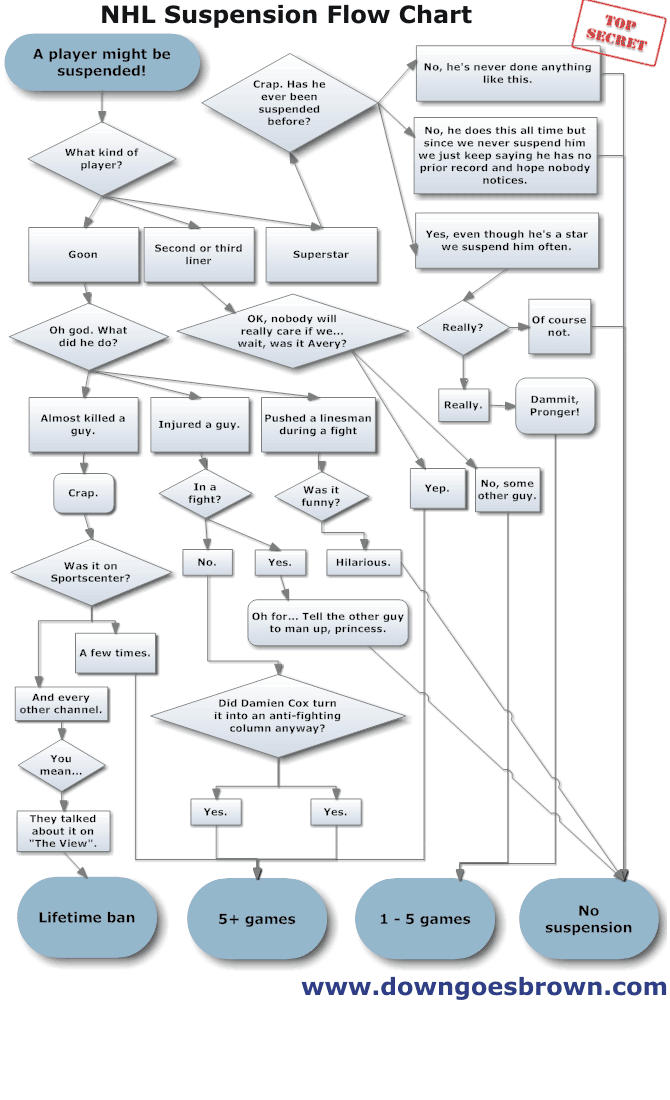
The NHL's top secret flow chart for handing out suspensions

The NHL's discipline policy has been in the news again lately. We've seen various incidents involving Alexander Ovechkin, Mike Richards, Curtis Glencross, Colton Orr and others, not to mention the OHL's season-long ban to Mike Liambas.

And as always, the NHL's suspension decisions have been criticized. It's the usual refrain: discipline is handed out haphazardly, almost randomly, and there doesn't seem to be any sort of consistency.

Nonsense. The criticism is unfair and unfounded. The NHL has a clear policy when it comes to suspensions, and the policy is followed faithfully. The league just hasn't decided to share it. So I'm doing it for them.

Yes, I have a copy of the NHL's discipline policy. And given recent events, I think it's only fair that hockey fans everywhere get to see it.

So here, straight from the desk of Colin Campbell himself, is the super top secret policy for handing out suspensions:


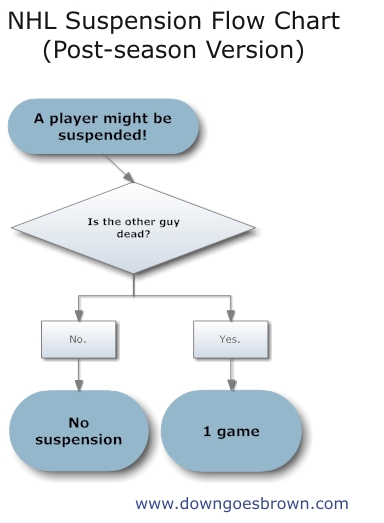
By the way, it should go without saying that this policy applies only in the regular season. There's a separate policy for the post-season, which can be found here:


There. So much for "random suspensions". Don't you all feel silly now?

Other DGB posts like this one: