Showing posts with label baumgartner. Show all posts

Friday, February 8, 2019

Grab Bag: Checking in on the remaining RFAs, a no-trade clause proposal and Rob Ray fights a fan

In the Friday Grab Bag:
- With Auston Matthews signed, let's check in on the remaining big-name RFAs
- I have a proposal for how the league should handle no-trade clauses
- An obscure player who had one of the craziest shifts in hockey history
- The week's three comedy stars
- And a YouTube look back at the time Rob Ray pummeled a fan

>> Read the full post at The Athletic

(Want to read this post on The Athletic for free? Sign up for a free seven-day trial.)


Wednesday, September 16, 2015

It made sense at the time: A brief history of jerseying

Hockey history is a rich tapestry of traditions, trends, and innovations. Many stuck around to become part of the game’s enduring fabric. Others … not so much. Today we will look back at one of the odder things that used to be part of the NHL’s culture and wonder how exactly it made sense at the time and that everyone was OK with it.

Have you ever been in a fight with a Canadian? Probably not, since we’re generally a friendly and non-threatening bunch. But there are certain lines that you just cannot cross, like disparaging socialized medicine or saying you thought Shawn Michaels was better than Bret Hart, and crossing those lines can lead to the nearest Canadian setting aside the Margaret Atwood novel they’ve been pretending to read and throwing down.

And when that happens, you’ll notice that while fighting a Canadian is a lot like fighting anyone else, there are certain key differences. We apologize after every punch. We pause every few seconds to take a sip of our double-double. And, at some point in the fight, we are going to try to yank your shirt up over your head.

That last one may seem a little odd, but don’t worry; we’re just instinctively reverting to what we grew up with. That’s because every Canadian is raised on a steady diet of watching hockey, and for several decades, that shirt-yank move was standard operating procedure in any hockey fight. It even had a name: “jersey,” used as a verb. As in “I was losing the fight, but then I jerseyed him and went to town.”

Jerseying is rarely seen these days thanks to the introduction of the tie-down, a small strap that connects the back of a player’s jersey to the top of his or her hockey pants. Today, the NHL has a rule that makes tie-downs mandatory for any player who fights, so with only rare exceptions, you don’t see a player’s sweater come off during fights anymore.

And that’s probably good news, because man, the whole “jersey over the head” thing really did get progressively weirder over the years.

>> Read the full post on Grantland


Tuesday, July 29, 2014

The Forrest Gumps of the NHL

Let’s go back in time to 20 years ago this month. It’s July 1994. The Rangers have just snapped a 54-year Stanley Cup drought, the Panthers and Mighty Ducks have finished their inaugural seasons, Wayne Gretzky has won his final Art Ross, and the rookie of the year is a fresh-faced goalie named Martin Brodeur. The NHL is booming and on the verge of finally surpassing the NBA, as long as it doesn’t go and do anything stupid like letting its new commissioner lead the league into a pointless lockout.

And while all of this is going on, a lovable dunce named Forrest Gump is ruling the box office. Tom Hanks won an Oscar for his work in the title role, bringing to life a character with a talent for spewing syrupy catchphrases and accidentally wandering into some of history’s greatest moments.

NHL players have never been much for catchphrases, unless you want to count “play a full 60 minutes.” But a few players have had an odd knack for the other half of Gump’s trademark. Here are five NHL players whose careers ranged from mildly successful to downright disappointing, but who somehow managed to make multiple appearances in the history books all the same.

Ty Conklin raises the roof

Conklin is just about the archetype of the journeyman backup goalie. In an NHL career that spanned more than a decade, he played for six franchises and never had a year when he started the majority of his team’s games. He wasn’t drafted, and he never won an award, played in an All-Star Game, or even started a playoff game. He just bounced around, signing free-agent deals and doing a reasonably dependable job for whichever team he managed to latch on with.

In fact, you could argue that Conklin had one of the most forgettable careers of any goalie who ever stepped foot inside an NHL arena. But that was the key — he was only forgettable inside. Because once they started playing games outdoors, Ty Conklin somehow became the most prolific goaltender in NHL history.

Despite never being a full-time starter, Conklin found himself as a starting goaltender in the league’s first three regular-season outdoor games. He started that streak in 2003, when the Oilers hosted the Canadiens in the inaugural Heritage Classic. Thanks to an injury to Edmonton starter Tommy Salo, rookie backup Conklin got the start in what at the time was assumed to be a one-off event.

But four years later, the league headed outdoors again for the first Winter Classic, with the Sabres hosting the Penguins. Conklin was in Pittsburgh that year backing up Marc-Andre Fleury, and when Fleury sprained his ankle, Conklin got the start again. He was the winning goalie, even making a spectacular save to set the stage for Sidney Crosby’s shootout winner.

The following year, Conklin was backing up Chris Osgood in Detroit when the Red Wings headed to Wrigley Field to play the Blackhawks. Needless to say, Osgood got hurt and Conklin was pressed into action yet again, earning the decision in a 6-4 Red Wings win.

Sadly, that would spell the end of his outdoor streak, thanks to the NHL’s stubborn refusal to implement my proposed “Just give the Winter Classic to whichever team employs Ty Conklin” rule. But he did come close to a fourth appearance; he was a member of the Red Wings when it was announced that Detroit and Toronto would face each other in the 2013 Winter Classic. That year’s lockout postponed the game and spelled the end of Conklin’s pro career — not to mention sparing starter Jimmy Howard from an inevitable mysterious injury.

>> Read the full post on Grantland


Thursday, November 27, 2008

Five for fighting: The five worst Leaf goons

Over the years, the Leafs have had their share of entertaining tough guys. Tiger Williams and Tie Domi are two of the all-time greats, and guys like Ken Baumgartner, John Kordic, Craig Berube and Wade Belak all had their moments.

But you can't win them all. And if you're one of the guys below, you couldn't win any of them some nights.

In honor of Andre Deveaux's debut, and the inevitable flood of goonery that's about to start as a result of Brian Burke's arrival, let's take a look back at the five least effective Leaf enforcers.

#5 - Greg Smyth

Here's what I remember about Greg Smyth: I remember the trade that brought him to Toronto in exchange for cash(!) being announced during a mid-week Leaf game on Global TV. I remember him having hockey hair and a pornstache. And I remember he had two stints with the Leafs, once in 1993 and again in 1996.

That's it. I have no recollection of him ever doing anything with the Leafs. At all.

Neither does youtube, apparently, so here's a clip of Smyth fighting Bob Probert:


#4 - Nathan Perrot

Perrot was a minor league tough guy who had enjoyed a brief stint in the NHL with Nashville before the Leafs acquired him and assigned him to the AHL. He played a half season in Tornto in 2003-4, not doing much, and made the team in 2005-6. However, Perrot's claim to fame in Toronto is his (alleged) refusal to fight Brian McGrattan. That lead to the veteran Domi feeling obligated to step up, which didn't go well for him.

Perrot never played another game for the Leafs, who shipped him to the Stars for a late-round pick a week later. Oddly enough, he was reacquired by the organization in 2007 and played a handful of games with the Marlies, but never made it back to the NHL. He's currently in Russia.

Here's Perrot doing what Leaf enforcers do best: feeding Chris Neil.


#3 - Kevin McLelland

Remember when Kevin McLelland was one of Wayne Gretzky's bodyguards in Edmonton? He was a pretty good enforcer back then. A few years later, when he wound up with the Leafs in 1991... not so much.

Here he is taking on Mike Peluso. I'm using this clip because of the bonus clip at the very start.


#2 - Ryan Hollweg

He's terrible.

When Ryan Hollweg isn't trying to cripple guys with cowardly hits from behind, he's busy viciously attacking opponents' fists with his face. Here he is doing what de does best (bleeding) against Michael Rupp of the Devils.


#1 - Kevin Maguire

Maguire made his debut with the Leafs in 1987, then went on to establish a name for himself in Buffalo. He was perhaps best known for trying to fight Steve Yzerman, which isn't a good idea when Bob Probert is on the ice. (Watch the whole clip, and compare Probert to Stu Grimson's reaction to the Clark/Marchment fight. This is the difference between a guy who wants to fight, and a guy wants to look like he wants to fight.)

Maguire wound up back in Toronto in the early 90s, where he briefly formed a tag team with McLelland that gave opposing tough guys the chance to brutally beat up two Leafs on the same night.

But he earns top spot on the list based on this:


Yes, that's Maguire fighting Wendel Clark in practice.

I mean... what would have to... how could you ever think that...

Are you fucking insane?

It's never a good idea to fight Wendel Clark, but at least guys who played for other teams had some sort of obligation to try. There was something vaguely admirable about seeing another team's enforcer challenge Clark, willing to take one for the team even though he knew he was about to die.

But when Clark is your teammate, and you still try to fight him... you, sir, are the dumbest man in the history of time. That kind of stupidity is more than enough to earn top spot on this list.


Wednesday, October 15, 2008

Top 10 Norris Division Tough Guys

The Leafs opening week schedule felt like a blast from the past, a link back to the old glory days when hockey was truly at its best.

No, no, not the Habs game. Screw those guys. I'm talking about the matchups against the Red Wings and Blues. With rare games against both teams in the same week, Leaf fans could be excused for feeling like for a few short days they were back where they belong: in the Norris Division.

Ah, the Norris. Perhaps the greatest division in hockey history, at least as long as you don't count meaningless stats like wins. While the rest of the league was busy winning championships, the Norris squads were pounding the crap out of each other for a solid decade. And fans loved it.

So before we go back to playing the Northeast division every single game for three months, let's take a moment to look back fondly at those Norris days. Let's tip our caps and bang our sticks on the ice for ten guys who made the division what it was. Let's honor the 10 Greatest Norris Division Tough Guys.

First things first
For sake of history, the Norris Division technically existed from 1974 to 1993, when Gary Bettman realized that hockey fans really loved the division names and wisely decided to change them to something non-fans in Alabama would like instead.

However, everyone knows that the real Norris Division was the 1982-1992 version that features the Leafs, Wings, Hawks, Blue and North Stars. That's the version we're talking about here. Sorry Lightning, you never counted.

Tough guys who played in the division outside of those dates aren't eligible, which is why you don't see guys like Tie Domi or Tony Twist. I've also focused on enforcers who were primarily there to fight, which is why you don't see power forwards like the Sutters, Gerard Gallant, and especially Wendel Clark who would have occupied all ten spots of the list if I'd included him and for the record could (and did) punch all the blood out of any guy listed below.

On to the list...

10. Kelly Chase
Norris team: Blues

Chase had two runs with the Blues, one Norris and one post-Norris. He was a classic Norris enforcer: always willing to drop the gloves to protect a teammate, to avenge a wrong, or just because the game was getting a little bit boring. This old Saskatchewan farm boy was fixture in St. Louis in the early 90s.

On a side note, Chase recently made news when he announced that he's been diagnosed with a brain lesion. Get well, Kelly.

Here's Chase standing tall with Ken Daneyko:


9. Mike Peluso
Norris team: Blackhawks

Peluso's best year as a Norris slugger was 1991-92, when he managed an impressive 408 PIM. Of course, Peluso rarely won his fights, but he makes the list based on sheer volume.

True fact: Peluso is one of the two best Mike Pelusos to ever play for the Blackhawks. (Editor's note: Pelusoes? Pelusi?)

Here's Peluso trading haymakers with the Missing Link:


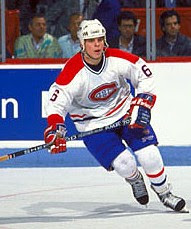
8. Ken Baumgartner
Norris team: Maple Leafs

The Bomber only played parts of two seasons in the real Norris, although he had a lengthy run in Toronto -- first as the undisputed heavyweight, and later as Tie Domi's wingman. But he makes the list by virtue of being arguably the best technical fighter of his generation -- he was one of the few guys who could switch hands easily, and his ability to hold off an opponent meant he virtually never suffered a clean loss.

He was also the first enforcer to intentionally remove his jersey before a fight, making him largely responsible for the league mandating tie-downs. I'll leave it to the reader as to whether that's a plus or a minus.

Here's a classic bout with Cam Russell with a unique ending:


7. Stu Grimson
Norris team: Blackhawks

Like Baumgartner, Grimson would be higher on the list if he had played more than two years in the real Norris. Still, he gets in by virtue of his nickname ("The Grim Reaper"), and his general level of insanity.

Here's Grimson going looney tunes against the Maple Leafs:


6. Dave Manson
Norris team: Blackhawks

Manson comes close to being disqualified due to an under-rated level of skill. He was a solid defenceman. But he was also a scary guy (especially later in his career when his shattered voicebox made him talk like a movie villain) and had a memorable running feud with Scott Stevens.

Like most Blackhawk tough guys, Manson did his best work against the Leafs. Here's the best thing he ever did, breaking up the Leeman/Savard debacle and earning the rare triple-game misconduct in the process:


5. John Kordic
Norris team: Maple Leafs

First, the bad news. Kordic was nuts, was a heavy drug-user, and eventually died during a struggle with police.

The good news, at least as far as this list goes, is that he was a top-ranked heavyweight who brought desperately needed toughness to the Maple Leafs. Long-time readers already know why Courtnall-for-Kordic was a good trade, but here's the quick summary: at the time, the Leafs were a wimpy team who were getting killed in the Norris, and Kordic changed that in a hurry.

Here's the classic Kordic-McRae scrap. God I miss the Norris.


4. Shane Churla
Norris team: North Stars

Churla was the Stars policeman from the late 80s through the end of the Norris era, before he was tragically murdered by Pavel Bure.

Here's Sugar Shane in a classic with Darren Kimble:


3. Basil McRae
Norris team: All of them

Yes, McRae gets a special mention for playing for all five Norris teams at some point in his career. But his best work came with the North Stars from 1987-1992, a string that included three straight years of 350+ PIM.

He was never one of the most feared fighters in the league, and was rarely the biggest guy in a fight. But he was the prototypical grizzled veteran who never backed down from a chance to defend a team mate. If you don't respect Basil McRae, you don't like fighting.

Here's a classic playoff bout against The Reaper:


2. Joey Kocur
Norris team: Red Wings

Kocur is the smallest guy on the list at barely 6'0, but may be the downright nastiest. He wasn't even the toughest guy in his family (that would be cousin Wendel), but he was the toughest guy in just about every fight he ever had. Like Wendel, Kocur didn't have a jab. It was all haymakers, just like starting up the lawn mower in Kelvington, and Kocur sure knew how to land them.

Here's Joey's infamous destruction of Jim Kite:


1. Bob Probert
Norris team: Red Wings

We have some fun with Probert around here because of his many losses against Wendel Clark. But if losing to Wendel Clark meant you weren't tough then this list would have zero names on it, and besides Probert at least managed to skate away from all of his Wendel scraps which is more than most guys can say.

Beyond that, all you need to know about Probert is that he was so fearsome that when he did lose (Tie Domi, Troy Crowder) it was front page news. And he always took care of business in the rematch.

Here's Probert's all-time classic against Craig Coxe of the Canucks:


Agree? Disagree? Who did I leave out? Square off in the comments section, but don't forget to wait until a half-second after the puck drop.



Wednesday, August 27, 2008

92-93 Trivia: The answers

Thanks to everyone who participated, and congratulations to General Borschevsky, eyebleaf, The Meatriarchy and mf37 for being the first to come up with various correct answers. (If you missed the original post, click here.)

#1 Who scored the goal that gave Gilmour a record-tying sixth assist in one game?

Good old Dave Ellett. Joe Bowen's call was classic (aren't they all?)

#2 In the late stages of game two against the Wings, and well on their way to a 2-0 deficit in the series, the Leafs showed some fight during a mini-brawl that featured Doug Gilmour taking down Bob Probert and Bob Cole's famous call "and oh, we're going to have a donnybrook here". Which Leaf threw the series of sucker punches that started the fight, and who was his (deserving) target?

It was the normally mild-mannered Felix Potvin, who drilled superpest Dino Ciccarelli to touch off the rumble. This was the first indication that Felix wasn't the pussycat we all thought he was. Of course, years later Ron Hextall would confirm this theory the hard way.

#3 After Borschevsky scores the goal to eliminate Detroit, who's the guy going crazy with the water bottle on the bench?

It's then-waterboy and current equipment manager Brian Papineau.

#4 Wendel Clark famously beat Bob Probert in a pair of fights during a December game at the Gardens. Other than the fights, what else was notable about that game for Probert?

It was Probert's first game back in Canada after a lengthy time when he couldn't come north because of his legal troubles. After this game, Probert immediately sent his lawyers back to court to ask that the ban be reinstated.

#5 Who was Pat Burns referring to when he made his infamous "I wouldn't know him if I ran over him with my truck" quip? Bonus question: what was that person's comeback?

Burns was referring to Bill Berg, who had just been claimed off waivers by the Islanders. The story goes that when Berg arrived in Toronto, he was asked what he planned to do first and replied "Probably find out where Pat Burns parking spot is".

#6 What classic Canadian rock song greeted the Maple Leafs before their first home playoff game in three years?

The Boys Are Back in Town, by Thin Lizzy. If the boys want to fight, you better let them.

(Update: This was also a trick question, since apparently Thin Lizzy aren't actually Canadian.)

#7 The day after Wendel Clark beat his face in, Marty McSorely appeared on the cover of the Toronto Star with a massive shiner. According to the headline next to the photo, who was "in the hangar, awaiting orders"?

Who else would be in the hangar but The Bomber?

#8 Which media member was honored with their own novelty rap song? Bonus question: according to the lyrics, "Lackawack, Cheektowaga, all through Buffalo, he's know as the ..." what?

It was play-by-play man Joe Bowen. In addition to referring to him as "the mic commando", the song had a chorus that focused on Bowen's call of a certain scrap.

#9 The Leafs used three different artists as anthem singers during the 1993 playoffs. Two regulars who alternated, and a third artist who made one disastrous appearance. Name all three artists.

I have to admit, I think I originally had this one wrong. I could have sworn that the Barenaked Ladies sang the anthem before Game Six of the Wings series. But I think I'm mixing up my anthems and General Borschevsky is right -- it was actually Pat Burns' favorite country band, the Good Brothers. In any event, they did a horrible meandering version of the anthem that killed the crowd and helped the Leafs get blown out.

The two good singers were Michael Burgess and John McDermott, although I would have also accepted "The guy from Les Mis" and "The Irish guy".

#10 Prior to Leafs/Kings game seven, CBC played an awesome montage of highlights from the series. The montage was set to the theme song from which sports movie?

Confession: I love sports montages. Back in the 80s and early 90s they were everywhere, and I loved it. These days you don't see them as often (although the amateurs on youtube are bringing them back). This one was one of my all-time favorites.

Anyways, the song here was theme from Hoosiers. You can hear it in this otherwise random youtube video starting at about the 1:15 mark.


Wednesday, February 20, 2008

Russ Courtnall for John Kordic was a good trade. No, I'm not drunk.

Russ CourtnallAs we approach the trade deadline, let's take a look back at one of the most infamous deals in Leafs history: the 1988 deal that sent Russ Courtnall to the Canadiens for John Kordic.

All things considered, this was a good deal for the Leafs.

(Sound of needle screeching off of a record.)

Yes, you read that right. I defend the Courtnall-Kordic deal. And yes, I realize I'm the only person in the world who does.

Everyone else thinks it was a terrible deal. Even Gord Stellick calls it a bad trade. In fact, it's become the gold standard of bad Leaf deals, even above the ridiculous "Tom Kurvers for a first round pick" deal that set the franchise back ten years. Even people who don't follow the Leafs and couldn't pick Russ Courtnall out of a lineup will mention it. Do a google search for "Kordic" and "Courtnall" and "Worst Trade" and you get almost 200 results.

So am I right and everyone else in the world is wrong? Yes, actually, and I'll tell you why.

First, the facts.

Fact #1 - The Leafs team of the late 80s had a decent amount of skill. They had three 30-goal scorers (Olczyk, Leeman and Marois) as well as a young Vincent Damphousse, decent second-line talent like Tom Fergus and some skill on the backend with guys like Salming and Iafrate. But they were soft. Like, squishy-donut-filling soft. Like, teddy-bear-right-out-of-the-laundry soft. They were so soft that they're probably the only team in history that could be pushed around by this year's Leafs.

The team did have the undefeated, undisputed heavyweight champion of the universe, Wendel Clark. But this was right in the middle of the three-year stretch where Clark played only 73 games total (including only 15 in 1988/89) so he couldn't help much.

The previous year's team had been soft too, and since then they'd parted ways with Al Secord and Dave Semenko. The 88/89 squad opened the season with one marginal tough guy in Brian Curran, and that was pretty much it. Other than Curran, do you know which opening night Leaf went on to have the most PIM that year? Mark Osborne. That, my friends, is soft.

Fact #2 - The Leafs played in the Norris division. For you youngsters who are too young to remember the Norris, let me try to describe it. Remember those Red Wings vs. Avalanche games a few years ago? That was the Norris division, every night. And with eight games against each division rival, the Leafs spent almost half their schedule playing Norris games.

Here are some players on Norris division teams that year: Bob Probert, Basil McCrae, Joey Kocur, Mark Tinordi, Kris King, Shayne Churla, Link Gaetz, Todd Ewen, Dave Manson, Bob McGill, Craig Coxe and various Sutters.

And again, the Leafs had Brian Curran and, um, Mark Osborne. See a problem here?

OK, this next one is important, so pay attention.

Fact #3 - Russ Courtnall wasn't that good. Yes, I said it. Courtnall was a decent player with great speed, who showed occasional flashes but was generally inconsistent and soft. And that's about it.

Here are some quick facts about Russ Courtnall. Keep in mind that he played during the highest scoring era in hockey history.

  • He had one 30-goal season in his entire career. One. Tom Fergus had two. Daniel Marois had two. Marion Statsny had two. Russ Courtnall, who everyone thinks was really good, had one.

  • He never had a point-a-game season. Not once. His career best season was 80 points.

  • He wasn't on the Habs team that won the Cup in 1993. This is really irrelevant, but it bugs me. He played for the North Stars in 1993. You just think he was on the Habs because he was still on their top line in NHL 93.

  • When the Leafs traded him, he had two points in nine games.

So why does everyone think he was superstar? Largely because the Toronto media feels a need to ridiculously over-rate any young player who the Leafs trade away. They did it with Courtnall. They did it with Kenny Jonsson. They're doing it now with Brad Boyes, even though he's halfway to his goal of playing for every NHL team in his career.

The bottom line
Imagine this scenario: You're an NHL GM. You have a lineup filled with reasonably skilled but generally soft players, playing in the toughest division in hockey. You need a heavyweight to protect them. You have a chance to acquire one, but it will cost you a skilled young winger who's shown flashes of brilliance in his early years. Are you a dummy if you make the deal? Would it be one of the worst trades ever? If you said "yes", then you owe Cliff Fletcher an apology, because he made the exact same deal three seasons later when he sent Daniel Marois to the Islanders for Ken Baumgartner. See, you fell right into my trap! I'm so frightfully clever. If anything, Marois had been a better player in his career before being traded than Courtnall ever was -- he was two years removed from a 39-goal season. But the Leafs needed a heavyweight, Fletcher made the deal, and it worked out brilliantly for the Leafs. Marois was out of the league within a few years and Baumgartner was a small but crucial piece of the early 90s Leafs resurgence.

Kordic, meanwhile, did everything the Leafs asked of him for two season, going toe-to-toe with any heavyweight he could find. But he had severe personal problems (which the Leafs may or may not have known about when they made the deal) and died in a drug-related incident when he was 27. So why is one deal applauded and the other is the "worst ever"? Hindsight, of course. Now we know that Marois had peaked, and Courtnall would have a solid career, and Baumgartner would become a crafty veteran, and Kordic was a ticking time bomb. It's easy to look at trades in hindsight and pick winners and losers. But that's not the way that NHL GMs have to make deals. They have to go based on what they know, and what they can project, at the time the deal is made -- with all the risk and uncertainty that involves. It's not fair to evaluate a trade any other way.

So fall back on 20/20 hindsight if you want to. But at the time the Kordic-for-Courtnall deal happened, it was absolutely the right move for the Leafs.