Showing posts with label zezel. Show all posts

Tuesday, December 13, 2016

A brief history of hockey's weirdest own goals

Welcome to the club, Patrik Laine.

On Sunday night, the rookie took a break from the monotony of scoring highlight-reel goals for the Jets to try something new: Scoring a highlight-reel goal against the Jets. It turns out he’s really good at that, too.

From a purely artistic perspective, that’s a pretty sweet goal. Stick on the ice, quick release, far corner, all done late in a tie game with the pressure on. It would have been nice to see him go bar down there, but he’s only a rookie.

He's also got plenty of company. NHL history is filled with players scoring into their own nets. So today, let's celebrate that history by taking a look at 10 of the more entertaining own goals from NHL history. This won’t be a comprehensive top-10 countdown, but a sampling of some of the more creative ways to put the puck into your own net. And we'll rate them using the following criteria.

Situation: Timing matters. An own goal in the preseason is just funny. One that comes in the playoffs might be career-defining.

Cringe factor: How bad did it look? Accidentally tipping a point shot or having a centering pass deflect off your skate isn't a big deal—that stuff happens all the time. We're looking for a goal that makes you scream "What was he doing?" at your TV.

Notoriety: Hindsight is funny thing. Some of these goals seem to stick in the hockey world's collective consciousness, while others fade as time goes on.

We're not sure yet how Laine will fare on that last category, although you'd imagine he'd do reasonably well in the first two. He'd certainly wind up with a decent overall score.

But you're not alone, Patrik. And a few guys have had it a lot worse than you did.

Paul Coffey, 1996

Situation: 6/10 – This one came in the opening round of a conference final. And not just any conference final—one between the two greatest rivals of a generation, the Red Wings and Avalanche. Everything that happened between these two teams was memorable, from the crazy brawls to the cheap shots to the embarrassing bloopers.

So why does barely anyone remember this one?

Well, here's the thing: It's from game one of the 1996 series between the two teams. In game six, this happened, and the rivalry was on. But at this exact moment in time, the Wings and Avs were just two teams.

Cringe factor: 7/10 – You can see exactly what he was trying to do, but it still ends up looking awful. And we'll award one bonus point for the Detroit crowd's reaction, and another for Bob Cole's fantastic call.

Notoriety: 4/10 – This one didn't resonate the way so many of the future moments between the two teams would. Still, this was a key goal in a game that went to overtime and that Colorado won. They took the series in six, so if this play never happens... well, who knows?

Overall: 5.7/10 – If only Coffey had been shown a cautionary example of the danger of defenseman own goals back in his formative years as an Oiler. Oh look, the "ironic foreshadowing" light on the dashboard just started blinking.

Bryan McCabe, 2007

Situation: 5/10 – On the one hand, this goal was from a mid-October game between two teams who'd miss the playoffs. On the other hand, it did come in the dying seconds of overtime. We'll split the difference.

Cringe factor: 7/10 – You can see what he's trying to do, and in a goal-mouth scramble it makes sense to try to get the puck out of the crease as quickly as possible, but it still looks bad. And the top-down camera view with the ticking clock in the corner doesn't help.

Notoriety: 8/10 – Considering this came in a game that ultimately didn't remotely matter, it's kind of strange that so many fans remember it to this day. A big part of that is the context here, which is that the Maple Leafs were bad and their fans were getting sick of it. Rightly or wrongly, McCabe was already becoming the lightning rod for that wrath, so everything he did was magnified. A few months later, the Muskoka Five were born, things got even worse, and this goal came to retroactive signal everything that was wrong with the JFJ era.

Overall: 6.7/10 – Like we said, hindsight is a funny thing. On the merits, this one probably shouldn't rank all that high. But some of these goals just stick, and this is one of them.

>> Read the full post at Sportsnet


Wednesday, August 17, 2016

Beyond Steven-for-Shanahan: Five more forced RFA compensation trades

Last week, we looked back on the league’s long history of arbitrators having to sort out messy cases. One of the biggest was the 1991 case that saw Scott Stevens awarded to the Devils as compensation for the signing of Brendan Shanahan. It was part of the league’s old RFA system, under which some players who signed with a new team weren’t subject to a right to match or draft pick compensation, but rather to a forced trade in which each team submitted what they felt was a fair offer and an arbitrator picked one.

It was, to put it bluntly, a fantastic system. Oh, the players hated it, and so did most of the teams. But for fans, it was a great source of entertainment. It was all sorts of fun to debate the teams’ offers, come up with ones of your own, and speculate over which side the arbitrator would ultimately land on. The system lasted until 1995, when Gary Bettman’s first lockout ended with a new CBA that ushered in new RFA rules. This excellent blog post contains a detailed history of the old system; it’s fair to say we’re unlikely to ever see it return in the NHL.

So today, let’s look back on five more cases where RFA signings resulted in an arbitrator forcing a trade as compensation. None were quite as big as the Stevens-for-Shanahan blockbuster, but each had its own impact on hockey history.

The battle of the enforcers

Despite having just two seasons and 69 games under his belt, Troy Crowder was one of the league’s most feared enforcers in 1991. That was almost entirely due to a single fight, one that came on opening night of the 1990-91 season. Crowder’s Devils were hosting the Red Wings, and midway through the game Crowder found himself squaring off with the league’s undisputed heavyweight champion, Bob Probert. The legendary Wings’ tough guy had a nearly spotless record over the years, but Crowder won the fight handily, a shocking result from a virtually unknown contender. When the two split a pair of January rematches, Crowder cemented his status as one of the league’s best.

And so, during the 1991 offseason, the Wings went out and signed him. The logic seemed sound – if this was one of the few guys in the league who could give Probert trouble, the Wings would make sure their big dog wouldn’t have to worry about him. The Wings offered Dave Barr and Randy McKay as compensation. But Lou Lamoriello and the Devils responded with the same strategy they’d used in the Shanahan case: swinging for the fences. They demanded Probert himself as compensation.

This time, the arbitrator wasn’t having it. Just days after they struck gold with the Stevens ruling, the Devils lost the Crowder case, and settled for McKay and Barr. Probert remained in Detroit for four more years, while a back injury limited Crowder to just seven games in Detroit.

Graves consequences

Today, Adam Graves is a Rangers legend. He was a key part of the 1994 championship team and once held the franchise record for goals in a season, and in 2009, the team retired his number.

But back in 1991, Graves was still a highly regarded prospect who hadn’t done much in the NHL. At 23 years old, he’d yet to so much as crack the 10-goal mark in four NHL seasons. So it was a mild surprise when the Rangers targeted him during the offseason, signing him away from Edmonton and opening the door to a compensation ruling.

The Oilers asked for Steven Rice and Loui DeBrusk, while the Rangers offered Troy Mallette. None of those were especially big names, and in some corners of the hockey world the Graves case didn’t get much attention. When the arbitrator sided with New York and sent Mallette to Edmonton, most fans shrugged.

But the ruling turned out to be a crucial one. The Oilers had had their eye on Rice and DeBrusk as part of a far bigger deal, one that would send captain Mark Messier to New York. That trade had been rumored for months, but had taken a backseat during the Graves case. But when Messier announced his intention to hold out in an attempt to force a trade, the Oiler had to make a move. And so, on October 4, 1991, they made a deal with the Rangers. In exchange for Messier, they’d get all-star center Bernie Nicholls and the two players they’d targeted in the Graves case, Rice and DeBrusk.

Would the Messier deal have still happened if the Oilers had already landed Rice and DeBrusk? It’s tough to say. In hindsight, it seems impossible to imagine Messier winding up anywhere other than New York. But he could have, if we’d seen a different decision in an arbitration case over a little-known prospect.

>> Read the full post at The Hockey News


Wednesday, August 10, 2016

Five times an NHL arbitrator actually got to do something

It’s been a rough few weeks for NHL arbitrators. While 25 contract cases had been scheduled for hearings, only Tyson Barrie made it to a hearing, and that was resolved before a ruling was issued, meaning the league’s arbitrators didn’t get to render a single decision. And all that comes on the heels of news that James Oldham, the neutral arbitrator who ruled on the Dennis Wideman case, had been dismissed by the league.

But during these dark days for the league’s proud arbitrating fraternity, it’s worth remembering that times weren’t always so tough. The NHL has a long history of arbitrators making headlines, on cases involving everything from contract signings to disputed trades and beyond.

Here’s a look back on five times in NHL history that an arbitrator got the chance to bask in the spotlight.

THE RFA FILES

The case: Today’s fans are familiar with the concept of restricted free agency. Certain players, typically those in the early stages of their pro careers, can find themselves eligible to sign offer sheets with other teams. If the offer isn’t matched, compensation is paid in the form of draft picks, based on a league-mandated scale. But the offer is matched, pretty much every time, which is why they’re rarely even attempted anymore and restricted free agency usually ends up being a dud.

Years ago, things were a lot more interesting.

Back before the current system came into place, the league went through a period where RFA signings were still subject to compensation. But instead of a list of draft picks and dollar signs, the compensation took the form of actual players. Each team – the one that had signed the RFA, and the one that was losing him – would have to submit what they thought was a fair trade to an arbitrator. And that arbitrator would have to pick one offer or the other, with no room to split the difference or compromise.

It was amazingly entertaining, and the strategy involved was fascinating. If you were signing another team’s RFA, would you lowball on your compensation to try to get the best possible value? Or did you make a generous offer just to make sure you weren’t burned? And if you were losing a player, did you retaliate by asking for someone even better in return?

OK, that last one sounds kind of over the top. But the New Jersey Devils tried it anyway, it worked, and everyone lost their minds.

The ruling: The player compensation system was used in all sorts of RFA signings over the years (I’m still not over the Maple Leafs losing Peter Zezel for Mike Craig). But the most famous case came in the early 90s, when the St. Louis Blues went on a spending spree targeting other teams RFAs. In 1990, they signed Scott Stevens away from the Capitals and named him team captain. And then in 1991, they went after Brendan Shanahan of the Devils.

Those were two big moves – Shanahan was a 22-year-old power forward who looked like a future star, and Stevens was already considered one of the best defensemen in the league. Put them together, along with established stars like Brett Hull and Adam Oates, and you had the core of a potential Cup champion. But as it turned out, it was the “put them together” part that ended up being a problem.

When it came time for an arbitrator to rule on Shanahan’s compensation, the Blues made a generous offer: Curtis Joseph and Rod Brind’Amour, two very good young players who’d go on to long and successful NHL careers. But the Devils shocked everyone by swinging for the fences and asking for Stevens. That seemed crazy – Shanahan was good, but Stevens was far better. But arbitrator Edward Houston stunned the hockey world by siding with the Devils, sending Stevens to New Jersey.

Understandably, the Blues flipped out. Stevens was also furious, initially refusing to report to the Devils before finally backing down shortly before the season started. The deal was a lopsided steal for New Jersey, one that helped set the stage for three Stanley Cups to come. To make matters worse, the Blues even tried to get Stevens back in 1994, and ended up getting nailed for tampering because of it.

To this day, Stevens-for-Shanahan stands as one of the biggest trades in NHL history. And thanks to an arbitrator, it was made against the will of one of the teams involved.

>> Read the full post at The Hockey News


Thursday, July 3, 2014

Grab Bag: More than a team

In the season' final grab bag (no really this time) (maybe):
- My picks for the five best and five worst FA signings
- The worst obscure player contract ever
- Did Don Cherry receive the Order of Canada?
- Comedy all-stars
- And the 1989-90 Washington Capitals lip synch their way through the legendarily awful anthem "More Than a Team"

>> Read the full post on Grantland


Friday, June 20, 2014

Grab bag: We could be heroes

In the grab bag:
- Debating whether coaches and players should speak nicely to the media
- In honor of the World Cup, an obscure player who may have been the greatest soccer player in NHL history
- Comedy all-stars, including topless Darryl Sutter
- What it's like to be on the ice after the Stanley Cup is handed out
- Capgeek trend tool sadness
- And an army of creepy children pay tribute to hockey heroes at the NHL Awards

>> Read the full post on Grantland


Thursday, November 26, 2009

Wendel Clark wants you to show some heart

Leafs fan
Hey cool, his fist still has little
bits of McSorley's skull on it.

Photo credit: Roger Hallett
Maple Leaf fans spend a lot of time talking about heart. We've celebrated the heart and soul guys who've worn the blue and white. We've had our heart broken by Kerry Fraser. And we watch the "All Heart" video every hour on the hour. Or at least I do.

Unfortunately, Leaf fans also know a little bit about heart problems. In recent years we've seen Luca Cereda's career-ending congenital heart defect, Pat Quinn's playoff arrhythmia scare, and Jonas Gustavsson's ablation. Only the JFJ-era teams seemed to escape heart problems, since Ferguson made sure none of the players he acquired actually had one.

This year, why not show a little heart of your own by helping out a great cause?

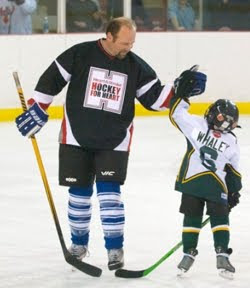
The Hockey for Heart tournament is the creation of Rob Weir. In 1993, Rob watched his father Roger die of a heart attack during a game of pickup hockey. Roger hadn't realized he had a heart condition. He was 46.

Rob launched Hockey for Heart in 1995 as a four-team tournament that raised $1,000 for the Heart and Stroke Foundation. Since then the tournament has expanded across Ontario and has raised over $890,000. Along the way, the tournament has had help from hockey royalty such as Johnny Bower (Roger's all-time favorite player), Darryl Sittler, Peter Zezel and Walter Gretzky.

Oh, and did I mention Wendel Clark?

Yes, Mr. All Heart himself is on board. He's been involved in the project for three years, and will be back this year for several tournaments.

This year's schedule begins in January and features stops in Toronto, Ottawa, Kingston, Hamilton and ten more cities.

Wendel Clark wants you to help out. You know what you have to do.

Here's how it works: Teams or individual players can register for their local tournament. Everyone gets three games (no contact, no slappers, just a rec-level fun time). Players raise money through sponsorships, and the top fund-raisers for each tourney get to take the ice for a special game against a team of pros and celebrities.

And yes, that means that you personally could wind up sharing a rink with Wendel Clark. If that opportunity doesn't get your attention, I'm not sure what you're doing on this site.

How you can help:
  • Visit the Hockey For Heart web site for a schedule of tournaments locations and other details
  • If there's a tournament near you, put a team together
  • If you can't get a full team, sign up to play as an individual (they'll find a team for you)
  • If you know somebody who's playing, sponsor them.
  • And if there's no tournament near you, why not show your support via Rob's player donation page?
I know Leaf fans have heart. Let's take this opportunity to prove it.


Sunday, October 18, 2009

Thoughts on the Maple Leafs "90s Night"

Maple Leafs 90s night
Would I be a loser if I pointed out that
that apostrophe is unnecessary?
When I first heard that Saturday night was going to be "90s Night" at the ACC, I was thrilled. I mistakenly thought it was an indication that the Leafs were planning to try something new and actually record a save percentage in the 90s.

Apparently not. But after finding out that the night was actually intended to honor various Leaf teams and players of the 1990s, I was still excited. After all, there may not be a Leaf fan on the planet who's spent more time chronicling the various highlights of the previous decade.

For those that missed it: the Leafs honored the 90s by having the current roster wear jerseys of 20 different ex-Leafs during the pre-game warmup. They also brought out Felix Potvin, Bill Berg and Mark Osborne to drop the puck.

And while I can't find a full list of the 20 Leafs who were "honored" during the warmup, the list was apparently based on the results of a poll on mapleleafs.com. And while the fan participation angle is nice, the actual poll was... well, bizarre. Have a look.

Can anyone figure out the point behind dividing up the players that way? I suppose they wanted to avoid having fans vote en masse for the players from the 1993 team because... well, I'm not actually sure why that would be a problem, but it's the best guess I can come up with.

But have a look at group three for the forwards -- you're telling me that only two of Sundin, Andreychuk and Borschevsky can be part of the Leafs all 90s teams? Really?

And it gets worse: check out groups four and five. Yes, fans, you get not one but two chances to vote for Todd Warriner, Mike Johnson and Freddy Modin!

And while guys like Eddie Olcyzk, Kirk Muller and Darcy Tucker didn't even make the voting list, we did get beloved former Leafs such as Darby Hendrickson and Mike Craig. I'm amazed they overlooked Brandon Convery.

Anyways, I have no idea whether the online poll was actually used in the end or not. It just seemed strange that nobody caught those errors.

Some additional thoughts:
  • At first I was going to criticize the team for not spending more time matching up the current and past players appropriately. I mean, Rick Wallin as Mats Sundin? But then I realized that we don't have any players worthy of wearing most of these guys' jerseys, so I felt better. And by "better", I mean "terrible".

  • Wayne Primeau as Wendel Clark? Ugh. They should have just had the real Wendel Clark take the skate. And then stay on the ice and play on the first line.

  • Ironic to see Mikhail Grabovski wearing Peter Zezel's jersey considering their respective faceoff skills. I'm pretty sure Grabovski would lose over 95% of his draws to Zezel. And not in their prime. I mean today.

  • Speaking of which, MLSE couldn't have thrown me a bone and had Grabovski play Berezin, and Ponikoravsky be Modin?

  • It was great to see Felix Potvin mentioned in the opening, and it was a brilliant move to use the occasion to replay his Hextall fight on the main scoreboard. I just wish Felix himself could have been there to take part in the ceremony. Anyone know why the Leafs invited his dad instead?

  • How many Leaf fans do you think watched the game at a bar, a party, or for some other reason had the volume turned down and momentarily thought they were having a stroke? Toronto's 911 lines probably lit up for a good ten minutes.

  • If you're going to a 90s night, why not go all out? You're telling me you couldn't have arranged for the anthem to be performed by Color Me Badd or Dee-lite?

  • Finally, I loved the idea for the ceremony and thought the execution was solid. But is anyone else concerned that we're starting to get a little Habby with all the ceremonies lately? I like an occasional nod to history as much as the next guy. But as a rule of thumb, if you find yourself holding a pre-game ceremony that prominently features an appearance by Mark Osborne, you might be overdoing it.


Monday, August 3, 2009

Great Obscure Moments in Leafs History - The final seconds of game seven against the Sharks

Great Obscure Moments in Leafs History - An ongoing series to honor the greatest, completely meaningless moments in Toronto Maple Leaf history.

By the time the second round of the 1994 playoffs rolled around, the Leafs had seen their last four playoff series end in the following ways:

That all happened in just 13 months. When it came to ways to end a playoff series, Leaf fans had run the gamut. There was absolutely nothing that could happen that they hadn't seen before.

What's that, Sylvain Lefebvre? You say you have an idea?


Hm, OK. Yes, that's a new one.

If you missed it, that's Leafs defenceman Lefebvre deciding, for some reason, to fire off a 200-foot wrist shot as time expires. But instead of floating down the ice, his shot drills innocent bystander Peter Zezel point blank in the chest. The puck bounces past a confused Felix Potvin and into the Leafs' net.

The goal was ultimately meaningless, since the Leafs had a 4-1 lead at the time. But it still results in the most muted game seven victory celebration in the history of sport, with all six Leafs on the ice standing around and staring at each in confusion. (Years later, Paul Maurice would install this as the team's official defensive system.)

Here are a half dozen things I love about this play.

Felix Potvin's reaction
Watch as Potvin turns around to stare at Lefebvre, then goes into his post-game crossbar tapping routine, then stops and turns to Lefebvre again.

I would love to know what was said here. I'm guessing it was something along the lines of "qu'est que c'est the hell was that, tabernac?" I think Potvin briefly considered going Hextall on him.

The Sharks' celebration
Nice work by the one Shark in the middle of the screen (who may or may not be Jeff Norton) who does the exaggerated stick-in-the-air celebration. Even though his season is officially over, he's going to passive-aggressively milk this late goal for all it's worth. Life is all about savoring the small victories.

In hindsight, of course, he was right. This goal is the best thing that's ever happened to the San Jose Sharks in the playoffs.

The fallout
There wasn't any. Nobody even remembers that this play happened.

But while we're on the topic, here's a question: when you think of a recent example of a defenceman scoring into his own net, who do you think of?

It's Bryan McCabe, isn't it?

Why? How did this become the gold standard for NHL own goals? I know McCabe was a whiny stiff by the end of his time in Toronto, but he scored his goal during a mad goalmouth scramble at the end of a meaningless regular season game that the Leafs were going to lose in a shootout anyways.

Meanwhile, Chris Phillips scored the Stanley Cup winning goal into his own net while the other team was changing lines, and nobody ever mentions it. Doesn't that belong up there with Bill Buckner and Scott Norwood?

And yet McCabe's play follows him for life, and Phillips never hears another word of it. Is it because McCabe once had a funny haircut? We're all OK with this? I mean, just let me know and I'll play along...

The gambling implications
I don't know what the spread or over-under on the game was. But you know that somebody, somewhere, lost a lot of money on this play. I'm sure they laugh about it now, though. They'd probably give this whole post a big thumbs up. You know, if they had any thumbs left.

Kevin Collins
The highlight of the video is the frenzied reaction of linesman Kevin Collins, who storms onto the scene, waving his arms and demanding that everyone pay attention to him.

Veteran ref Terry Gregson seems ready to let the whole thing go, but not Collins. He's going to make sure the goal counts, dammit. Watch his reaction at 0:25 when the horn blows, and he starts shrieking "NO!" like the hero in an 80's action movie who just saw his child gunned down.

Now it would be easy to make fun of Collins here, since he's acting like the smarmy grade school kid who reminds the teacher that they forgot to assign any homework. But he's right. A goal is a goal, and this one needs to count.

After all, you can't ignore the rules just because you're in the late stages of a crucial playoff game, right Kevin? You have to be able to make the tough call against the home team. The rules are the rules, and you can't just take the easy way out and pretend you didn't see what was right in front of you.

Right Kevin?

(Breathes deeply into a paper bag.)

Now I'm angry. I need to see something completely ridiculous to make me feel better about my life.

Damian Rhodes' hair
Yep, that'll do it.

Hey, looks like somebody's been using his Head and Shoulders!


Tuesday, May 26, 2009

Remembering Peter Zezel

Terrible news today, as Peter Zezel has lost his long battle with a rare blood disorder. Zezel passed away today at the age of 44.

Zezel played for seven teams in his NHL career, and was one of my favorite Leafs from the 1993 and 1994 teams. While he never put up much in the way of offensive numbers in Toronto, he was a tenacious worker and defensive specialist. Together with Bill Berg and Mark Osborne, Zezel formed arguably the best checking line the Leafs have ever had. Zezel was the best defensive center on those Leafs squads, which is saying something considering those teams also featured a Selke nominee in Doug Gilmour.

During the Leafs' deep playoff runs in 1993 and 1994, Zezel took just about every important defensive zone faceoff. While I don't have the stats in front of me, I'm fairly sure that he won 100% of them, despite never touching the puck with his stick. Zezel was the master of tying up an opponent and then working the puck backwards with his skates, not surprising given his talent for soccer (at one point during his Leafs stint he also played for the North York Rockets, making him one of the few Canadian athletes to play two different sports professionally).

While the Wendel Clark trade was the big off-season news of 1994, the loss of role players like Zezel and Bob Rouse did almost as much to spell the end of that Leaf team's run as a contender. Fifteen years later, the Leafs still haven't found a player to fill Zezel's faceoff specialist/defensive center role.

Other random memories:

  • His appearance in "Youngblood". Seriously, he's was in there. Even has his own IMDB page.

  • His thick neck, combined with a hunched over skating style, which made him the easiest Leafs player to impersonate. If you were a kid who played road hockey in the early 90s and you didn't get to be Wendel or Dougie, you could count on a laugh if you declared yourself Peter Zezel and then played a shift with your ears between your shoulders.

  • His key role in the Leafs elaborate pre-game ritual which would see the entire team gather around Felix Potvin's crease to offer the goaltender glove and stick taps. As each player left the crease they'd bang fists with Zezel, who stood twitching nearby until he was the last player remaining. At that point, he'd charge in a deliver a two-handed slash to Potvin's pads before sprinting off the ice. I always liked to imagine that the mild-mannered Potvin had absolutely no say in the conception of this ritual.
Send out some good thoughts to Peter Zezel and his family today.


Friday, April 11, 2008

Capital punishment

The gang over at Pension Plan Puppets have adopted the Washington Capitals as their temporary team.

Here's PPP's reasoning:

We're officially cheering on another team. Yes, I know I wrote an entire post about playoff hate but the consensus has been that you can't hate teams that have not done you any harm. The Leafs have never met in the playoffs, the two teams have never played any big regular season games, and any problems the Leafs have had recently with the Capitals have been self-inflicted.
Now, I like the Caps. Their fans have waited a long time for something to cheer about. They were kind enough to give us Peter Zezel and Bob Rouse, I always liked Dale Hunter, and Alexander Ovechkin is pretty much the coolest guy in the league.

The MCI Center even provided one of my favorite non-Leaf NHL memories. A few years back we were in Washington to visit the in-laws and had a chance to take in a Habs/Caps game. The arena was half-empty, of course, so we were able to pick up cheap tickets in the lower bowl. Halfway through the first period, a pane of glass pops out almost right in front of us and there's a long delay while they try to install a new one.

As we're sitting in the dead quiet arena, we notice a certain well-coifed official is supervising as the replacement pane goes in. My lovely wife suddenly stands up, leans towards the opening, and shouts "Hey Fraser, you jerk, you blew the Gretzky call and ruined my husband's life!"

He skated away -- I'm not sure if he heard her, or just saw a reflective surface somewhere he could gaze into lovingly. But some friendly Caps fans wanted to know the story behind it. After I told them about that game (which takes me about 45 minutes start-to-finish and involves profanity, hand gestures and an improvised Euler diagram), they agreed it was a travesty and bought us beer.

So I'll always have a soft spot for the Capitals. But I can't do it, PPP. I can't jump on another team's bandwagon, even temporarily. I'll watch. Maybe even cheer. But I won't call the Caps my team. I'm a Leafs fan and a Leafs fan only until the day I die (which will be this summer, by the way, of self-inflicted head wounds when we don't get Brian Burke).

Bottom line: I can't have a second-favorite team any more than I can have a second-favorite wife.

(Which, after double-checking, I'm told I definitely can't do.)