This weekend marks the 50th anniversary of Darryl Sittler’s legendary 10-point game. On February 7, 1976, Sittler scored six times and added four assists to power the Leafs to a win over the Bruins. With the feat coming on a nationally televised Hockey Night in Canada game, the record became a defining moment of 1970s hockey. The record still stands to this day.
Sittler’s record was recognized by the Maple Leafs during a ceremony last week, in the last home game before the anniversary. We dug into that record-breaking night in more detail that week’s newsletter, including an interesting bit of trivia: Not only has nobody ever matched Sittler’s 10 points, nobody in NHL history has even reached nine points in a game.
But while the ten-point club is exclusive and the nine-point club remains empty, the eight-point club is more crowded than you might think. There have been 15 eight-point games in NHL history, by a total of 12 different players. And let’s just say it’s an eclectic group.
On Sunday, we can celebrate Sittler’s night for the ages. But today, let’s recognize the 15 times that somebody has hit the eight-point mark, going chronologically from the first to the most recent.
And just like that, Wayne Gretzky’s unbreakable record has been broken.
Well, one of them. Gretzky had more than his share. But for hockey fans of my generation, it really is hard to believe that Alexander Ovechkin actually did it. He broke Gretzky’s career goals record. That wasn’t supposed to be possible.
For decades, old-timers like me figured there was just no way that anyone could get to 894. Not in the Dead Puck Era, which eventually gave way to the Only Comatose Puck Era. Not when it meant scoring at a 45-goal pace for 20 consecutive seasons. Not in an era where players were bigger and stronger, meaning just staying healthy was a challenge. Not in a league where forwards were supposed to peak in their mid-20s and then give way to the next generation.
But here we are. So now we have to ask: What other “unbreakable” records could we be wrong about?
We’ve had some fun in the past with unbreakable records, as well as a few breakable ones. But today, let’s look at some of the sport’s marks that have at some point seemed unreachable, and try to figure out if they could actually be in play.
Jesse already took a look at Gretzky’s other records, and I’m mostly on the same page. I’d argue that the nine Hart Trophies is probably unbreakable, given how much modern sportswriters seem to value the novelty of getting new names on their ballots. But I’d agree that the career points and assists records are untouchable, and I like Jesse stopping just short of taking the 92-goal regular season record off the table.
What about the records that aren’t Gretzky’s? Let’s have a look at 15 of the most imposing, and see if we can imagine them being broken someday.
With the Alex Ovechkin goals chase now down to single digits, it no longer feels like a question of if he’ll break Wayne Gretzky’s mark this season, but rather when.
We’ve already covered that question, a few weeks back. But there’s a second, and maybe even more important question that’s now looming: Will the record-breaking goal be any good?
The NHL is already worrying about this, especially the possibility that the record-breaker falls victim to their very bad and nit-picky replay review system. Other fans have been openly antagonizing the hockey gods with ideas for the most Team Chaos-worthy way the record could fall. (Personally, I’m a big fan of the “Ovechkin has an empty-net look against the Penguins but Sidney Crosby throws his stick for an automatic goal, meaning Sid's the one who actually ‘scores’ the record-breaker” scenario.)
Whatever happens, it will be a cool moment. But how cool? Just in case Ovechkin is looking for inspiration, today’s column is going to look at a dozen historic NHL goals that broke an important record. To be clear, we’re not worried about individual milestones, or important game-winners or sudden death snipes. We want the guys who broke a significant record, did it with a goal, and did it in style. Just like how we all hope Ovechkin will over the next few weeks.
We’ll use a modified version of the scale we established for the goalie goals ranking, with an emphasis on the creativity and/or skill of the goal itself. We’ll go from worst to best, which means there’s really only one pick for 12th spot…
With a few days to go until the trade deadline, Kyle Dubas and the Maple Leafs still haven’t pulled off their big move. Or maybe they have, and Jack Campbell was it. But most of the fan base seems to be expecting something bigger, preferably a top-four defenseman. And while Dubas doesn’t have much in the way of picks to work with, he could surely work a blockbuster using guys off of the current roster, or from the prospect pipeline. Do it Kyle! Swing for the fences!
Just one thing: Do not under any circumstances trade away somebody we’re all going to regret losing.
That’s the tricky part of making trades. Fans love the short-term adrenaline rush of seeing a big deal cross the wire. But something has to go the other way, and that will often be a player or two or more. And sometimes, those players can turn out to be pretty good.
That’s where the regret comes in, along with that sense of disbelief that anyone ever thought it would be a good idea to give up that guy in the first place. It’s a feeling that Maple Leaf fans know well.
How well? How about well enough to fill out a full roster, which is what we’re going to do today. Just in case there were any Leaf fans out there with a little bit of hope and optimism still clinging to this rollercoaster of a season, let’s wring that right out with a full 20-man roster of guys that the Leafs probably wish they hadn’t traded away.
A few quick ground rules. First, we’re only worried about what the player did over the course of his career after being traded away by the Leafs. We’re looking at trades only, not guys lost to free agency or waivers or various drafts. And finally, we’re only considering players, not draft picks.
That last one is important because it removes a few names you might be expecting to see. Scott Niedermayer was never Maple Leafs’ property. Neither were Tyler Seguin or Roberto Luongo, or John Gibson or Roman Josi, or any number of good players who were drafted with picks that teams acquired from Toronto. The Leafs have certainly had a bad habit of trading high picks over the years, and it almost always works out great for the team on the other side. But trading a pick isn’t the same as trading a player, and you never know who your team might have taken if they’d stayed in that spot. While it costs us some star power, we’re going to stick to players who actually belonged to the Leafs.
The good news is that we still have plenty of candidates to choose from. And by good news, I mean let’s all hold hands and feel sad together. We’ll build this team the way all those Dubas critics insist on, from the net out …
Goaltenders
Bernie Parent
The trade: Parent bounced around a bit early in his career, going from the Bruins to the Flyers to the Leafs before flirting with the WHA. That led to the Leafs sending his rights back to Philadelphia in 1973.
What he did once he left: Parent returned to the NHL for the 1973-74 season and immediately won the Vezina, Conn Smythe and Stanley Cup. Then he did it all again the next year. He was inducted into the Hall-of-Fame in 1984.
But it’s OK because the Leafs got: The 10th overall pick in the 1973 draft, which they used on Bob Neely. He played five NHL seasons and scored 36 career goals as a Leaf.
Tuukka Rask
The trade: Heading into the 2006 offseason, Maple Leafs GM John Ferguson Jr. found himself with two can’t miss goaltending prospects, but nobody to hold down the starting job at the NHL level. He kept Justin Pogge and sent Rask to the Bruins.
What he did once he left: Rask is in his 11th season in Boston, most of those as a starter. He’s won a Vezina, is closing in on the 300-win club and was part of a Cup winner in 2011.
But it’s OK because the Leafs got: Andrew Raycroft, in a straight-up deal. He lasted one season as the starter in Toronto, leading the league in goals against and then lost his job to Vesa Toskala. That may be the most depressing sentence I’ve ever written.
But remember, the Leafs also got to keep Pogge, who played (checks notes) seven NHL games. A lot of people forget that part.
In the Friday Grab Bag:
- Is Alexander Ovechkin the great goal-scorer ever? Sizing up some of the contenders for the crown.
- A weird playoff streak involving two Pacific teams
- An obscure player who is Scotty Bowman
- The week's three comedy stars
- And a YouTube look back at Darryl Sittler's 10-point game, 44 years ago tonight
In the Friday Grab Bag:
- A deeper look at that amazing NBC playoff portrait
- A word about postseason trolling
- An obscure player who knew how to start a playoff series
- The week's three comedy stars, featuring a victory lap from Mr. Lottery
- And a YouTube breakdown of the Leafs setting a playoff record exactly 40 years ago today, and celebrating it very weirdly...
It’s been a bad two years for the Ottawa Senators. Ever since they lost a heartbreaking Game 7 showdown with the Penguins in the 2017 conference final, the franchise has endured a seemingly endless series of setbacks both on and off the ice. The misery has been well-documented – you may have seen this epic Twitter thread – and the worst part is that some days it doesn’t feel like there’s any end in sight.
And, at some point, beaten-down Senators fans have probably wondered: From ownership to coaching to off-ice scandals to the steady stream of star players bolting for the exit, has any fan base ever had it this bad?
At which point Maple Leafs fans of a certain age might hobble over, waving their canes and mumbling ominously: You kids don’t realize just how bad it can get.
You see, some of us had to deal with the Harold Ballard era back in the 1980s. And while we can sympathize with what Senators fans are going through right now, we might object to the suggestion that Ottawa has it any worse than we did. We’ve seen some stuff, man.
So since the playoff version of the Battle of Ontario has been on pause for over a decade and doesn’t seem like it will be resuming anytime soon, let’s take the rivalry in a different direction. Who’s had it worse, modern-day Senators fans or 1980s Maple Leafs fans?
This is going to get depressing. Let’s go through 10 key categories and figure out which of Ontario’s teams can claim the suffering hockey fans’ crown.
Worst season
Let’s start with the basics. When you’re building a solid foundation of misery, you want to start from rock bottom.
Today’s Senators: While it’s still a work in progress, it’s fair to say that this year will go down as the worst in the Senators’ post-expansion history. They’re on pace for a point total in the low 60s and will likely finish last in the league for the first time since the Sparky Allison days.
The 1980s Maple Leafs: Despite finishing under the 60-point mark five times, the Maple Leafs somewhat amazingly only came in dead last once during the ’80s. That was in 1984-85, when they won just 20 games on the way to a pathetic 48-point season. The good news: They at least had their own draft pick, unlike some teams we could mention, and the guy they used it on turned out to be pretty fun.
Who had it worse? Based on points, it’s the Maple Leafs by a fair margin. But their worst season came during an era where horrible teams were commonplace, while the Senators are having theirs in what’s supposed to be the parity era. They’re also finishing last in a league with 10 more teams than the one the 1980s Leafs faced. I think you have to adjust for era here, and when we do this one comes out fairly even.
Best season
The flip side of the last category. Even a blind squirrel finds a nut every now and then, right?
Today’s Senators: It seems more amazing with every day that goes by, but it’s really true: The Senators really were one goal away from the Stanley Cup final just 21 months ago. Sure, in hindsight their three-round run was powered by some lucky matchups and good bounces, and it probably did more harm than good by convincing the front office that they were legitimate contenders. But it did happen, and it was all sorts of fun for Senators fans in the moment.
The 1980s Maple Leafs: The Leafs made the playoffs six times during the 1980s because they played in the Norris Division and somebody had to go. But they only won two rounds in the decade and never made it out of the division final.
Who had it worse? The Leafs get the edge here.
Franchise player falling outs
Even when things are bad, at least you’ve got a franchise player to cheer for. Right up until you don’t.
Today’s Senators: They watched Daniel Alfredsson walk away as a player in 2013 and then again as an executive in 2017.
Then they went through the same sort of situation with Erik Karlsson with some added off-ice drama, culminating in him being traded last fall. And then it happened yet again with both Matt Duchene and Mark Stone at the 2019 deadline. (And we haven’t even mentioned Jason Spezza or Dany Heatley.)
The 1980s Maple Leafs: The team’s relationship with Darryl Sittler went off the rails in the early ’80s. The front office wanted to move him, but he had no-trade protection, so they dealt his best friend Lanny MacDonald instead to send a message. That led to Sittler infamously cutting the captain’s “C” off his jersey, and he’d eventually walk out on the team citing doctor’s orders. He’d be traded to the Flyers a few weeks later.
Who had it worse? This one’s close. Nothing that’s happened in Ottawa can match the over-the-top ugliness of the Sittler situation. But I feel like you have to give the Senators a slight edge here just based on volume.
In the Friday Grab Bag:
- The brilliant fix for goaltender interference that's gaining support yet sounds vaguely familiar
- If we really need to change the Hart Trophy, I have an idea about how we should do it
- An obscure player who shows why just drafting the best player available can sometimes spell disaster
- The week's three comedy stars
- And a look back at the montage video the Kings put together for Wayne Gretzky's record-breaking 802nd goal
In the Friday Grab Bag:
- NBC seemed to snub the NHL this week, but maybe we're all missing something
- An idea for making outdoor alumni games a lot more fun
- An obscure player who had more success in reality TV than on the ice
- The week's three comedy stars, including an adorable wittle Blackhawks fan
- And we break down one of the most famous moments in WJC history, as John Slaney scores the biggest goal of his life
Tuesday night's Game 1 of the World Cup final, which saw Team Canada earn a 3-1 win over Team Europe, sets up a do-or-die Game 2 Thursday night. A Canada win would end the tournament, and the trophy will be in the building, unless the league has come to its senses and thrown that ugly thing into a raging bonfire instead.
There have been seven World and Canada Cups in international hockey history, but we didn't get to see a Game 2 in all of those. Twice, in 1981 and 2004, the format called for a one-game final. But it's been best-of-three in the other tournaments, which gives us five Game 2 to work with. So today, let's take a look back at those five games, and rank them from worst to best.
As always, this is opinion only, and if you disagree, then you're wrong.
No. 5 – 1984: Canada 6, Sweden 5
The road there: Canada stumbled through the 1984 tournament, going 2-2-1 through the round robin and barely making the playoff round as the fourth seed. But Team Canada earned a trip to the final thanks to an overtime win over the Soviets in the semi-final, and they were facing an upstart Swedish team that had beaten them in their round robin meeting and had just embarrassed the Americans with a 9-2 blowout. The Canadians took the opener by a 5-2 final, but the second game proved closer.
Game 2: The game looked like a laugher early on, with Canada scoring four times in the first seven minutes and adding a fifth before the first period was over. A Paul Coffey goal early in the second made it 6-1, setting the stage for a furious Team Sweden comeback. They scored three unanswered goals to close out the second period, and draw to within 6-5 early in the third. But that was as close as they came, as Canada held on for the win and the series sweep.
The aftermath: This turned out to be the first of three straight Canada Cup wins for Team Canada, and remains the only finals appearance by Team Sweden.
The bottom line: What looked like a laugher wound up being a reasonably entertaining contest. But the game everyone remembers from the 1984 Canada Cup will always be that semi-final thriller with the Soviets.
We're two games into the round robin portion of the World Cup, and we've already seen a handful of upsets, with favorites like Russia and the United States already tasting defeat, and in the case of the Americans, already being eliminated. With one game to go and some of the four playoff spots still up for grabs, fans around the world are no doubt panicking over the games their teams let get away.
But while the round robin is obviously important – you have to make the playoffs to win the whole thing – it's worth remembering that the results of individual games don't necessarily tell us much as much as we might think about what will happen in the playoff rounds.
In fact, the history of the World and Canada Cup tournament is filled with surprising round robin results that ended up getting flipped down the line. So in an effort to calm some nerves, here are five times that overreacting to a round robin result would have steered you wrong once the eliminations games began.
1976: Czechoslovakia 1 – Canada 0
In the first ever round robin game in Canada Cup history, Canada made a statement by crushing Finland 11-2. They went on the beat Sweden and the U.S., and they closed out the round with a win over their arch-rivals from the Soviet Union, winning those three games by a combined score of 11-3.
But in between, they dropped a surprising decision to Czechoslovakia. Vladimir Dzurilla outduelled Rogie Vachon at the Montreal Forum, turning aside all 29 shots he faced in a 1-0 win. The game was an instant classic, described at the time as one of the best ever played.
The two teams finished at the top of round robin standings, setting up a best-of-three final. But there was no repeat of Dzurilla's heroics – Team Canada blitzed him for four goals in the first period of the opening game, sending him to the bench and paving the way for a lopsided 6-0 win. Game 2 was more entertaining, with Canada jumping out to a 2-0 lead just three minutes in before a Czechoslovakian comeback set the stage for Darryl Sittler's tournament winner in overtime.
1981: Canada 7 – Soviet Union 3
By 1981, the Soviet Union was coming off a relatively rough stretch of international play. They'd won their usual Olympic gold in 1972 and 1976, but been upset by Team USA's Miracle on Ice squad in 1980, lost the 1972 Summit Series, and failed to even make the final of the 1976 Canada Cup.
When they met Canada in 1981 in the final game of the round robin, both teams were undefeated and battling for first place. The game was tied at 2-2 heading into the third, but Canada erupted for five straight goals in what ended up being a 7-3 laugher. Even with star goaltender Vladislav Tretiak sitting out due to illness, the result was an embarrassing one for the Soviets.
Both teams won their semifinal game to advance to a one-game winner-take-all final in Montreal. With Tretiak back in goal, most fans expected a closer game. Instead, they got an even bigger blowout. But this time, it was the Soviets who ran up the score, earning an 8-1 win and handing Canada what still stands to this day as its most embarrassing international loss.
What would Valentine’s Day be without an ugly breakup?
OK, so Evander Kane and the Jets were a week early. And technically, they haven’t officially broken up yet — that will come when Kane is traded, either in the next few weeks or during the summer. But it’s over. In any relationship, there are some moments you can still recover from. A player walking out on his team because players threw his tracksuit in the shower is not one of them.
So Kane and the Jets are done. But as they sob into their pillows over what might have been, it’s worth pointing out that this isn’t the first nasty breakup the NHL has ever seen. In fact, Kane and the Jets barely rate a mention when you consider some of the superstars who’ve seen things end badly with the team they were supposed to be meant for.
Today, let’s look back at 10 of the worst breakups in NHL history. Some of these relationships were in trouble for years. Some fell apart over the course of a few hours. And a few even eventually ended with everyone agreeing to stay friends.
(And don’t worry if I somehow left your favorite player off the list and you’re not sure you can ever forgive me. It’s not you, it’s me.)
1. Dany Heatley and the Senators, 2009
Happier times: Heatley had played four seasons in Ottawa, scoring 50 goals twice and establishing himself as one of the most productive wingers in the game. But the team was struggling, having missed the playoffs for the first time in 13 years, and Heatley didn’t get along with new coach Cory Clouston.
He said: Heatley wanted out because … well, we’re not quite sure, although the most likely explanation seems to be the simplest one: He just didn’t like Clouston. Either way, he was adamant that he’d played his last game in Ottawa. Oh, and he also intended to use his no-trade clause to force a deal to a team he liked.
They said: The Senators chafed at Heatley’s insistence on picking his destination. They struck a deal with the Oilers, only to have Heatley use his no-trade clause to kill the transaction. To make matters even worse, the situation dragged on long enough that the team ended up having to pay Heatley a $4 million roster bonus.
How it ended: The Senators eventually gave Heatley his wish, sending him to San Jose in a deal for Milan Michalek and others that most agreed was a lopsided win for the Sharks. They later went to court to try to get that bonus money back, in a case that wasn’t resolved until 2013.
Who won? The Senators. Heatley had one decent season in San Jose but has bounced around the league with several teams since then and is currently in the minors. Meanwhile, Michalek remains a relatively useful piece for the Senators.
2. Patrick Roy and the Canadiens, 1995
Happier times: Roy had almost single-handedly won two Cups in Montreal to go along with three Vezinas and the consensus “best goalie in hockey” title, making him the latest in the franchise’s long line of French Canadian superstars. Then, one December night in 1995, the Red Wings came to town …
He said: Roy didn’t get along with newly appointed Habs coach Mario Tremblay, and there’d even been unconfirmed rumors of physical altercations. In that infamous Red Wings game, the Canadiens were blown out 11-1, and Tremblay left Roy in for nine goals before finally pulling him. Feeling as if he’d been intentionally humiliated, Roy arrived at the bench, pushed past Tremblay, and told team president Ronald Corey that he’d never play another game for Montreal.
They said: “If there’s any problem, we’re going to solve it tomorrow,” Tremblay said. Spoiler alert: Nope.
How it ended: The team suspended Roy, and four days later it traded him to the Colorado Avalanche.
Who won? Roy, who led the Avalanche to their first Stanley Cup that year and won another in 2001. The Canadiens were roasted for not getting much of anything back for a future Hall of Famer, and they haven’t been back to the Stanley Cup final in the nearly two decades since.
After months of speculation, the San Jose Sharks finally named their new captain last week: nobody. They won’t have one this year, going with four alternates instead.
That’s going to be a little bit awkward for Joe Thornton, who wore the “C” last year before having it taken away after the Sharks’ painful first-round loss to the Kings, and is still on the roster. And then there’s Patrick Marleau, who was San Jose’s captain for five years until he was stripped back in 2009, and is also still on the roster.
But while the Sharks’ situation was unusual, and probably handled about as poorly as it could have been, it wasn’t unprecedented. In fact, lots of star players have had a “C” taken away over the years,1 and many times the whole thing has been handled quite amicably.
But “quite amicably” is boring. We want some bad blood. So for today’s history lesson, let’s look back at five cases of NHL captains who lost their “C” under less-than-ideal circumstances. You’re not alone, Joe — and some of these guys had it even worse.
Rick Vaive Hits the Snooze Button
Being the captain of the Toronto Maple Leafs during the Harold Ballard era was a tough job. Ballard was essentially every stereotype of a rotten, greedy sports owner brought to life, except worse. He was a miserable crank, not to mention a convicted fraud, and legend has it that he once shut off the Maple Leaf Gardens drinking fountains and cranked up the thermostat on a hot day to force fans to buy soda (on which, it goes without saying, he’d raised the price).
So it was no surprise that Ballard didn’t get along with his captains — or just about anyone, for that matter. In 1979, Ballard and GM Punch Imlach started a feud with Leafs franchise player and captain Darryl Sittler that culminated in the future Hall of Famer slicing the “C” off his own jersey with a pair of scissors. Sittler was eventually given the captaincy back, and wore it for two more years before finally tiring of Ballard’s sideshow for good and requesting a trade.
Vaive took over the Leafs captaincy during the 1981-82 season, the first of a franchise record three straight in which he’d score 50 goals. He held the honor until a Saturday morning in Minnesota in February 1986. Vaive had gone out with former teammate John Anderson for what he called a “late-night bull session” and overslept the next day. He missed a scheduled practice, and Ballard responded by stripping him of the captaincy. He was traded to Chicago a year later.
After the Sittler and Vaive debacles, the Maple Leafs apparently decided that captains were more trouble than they were worth, going without one for three full seasons. That ended with two years of Rob Ramage, which gave way to the beloved Wendel Clark–Doug Gilmour–Mats Sundin era. With Ballard long gone, these days captains are finally treated with some respect in Toronto. (Until the team loses a few games in a row, in which case we ask Sittler if we can borrow his scissors.)
MLSE also spent a ton of money on a tribute to
Toronto FC’s greatest players, but halfway through
the ceremony the best statues just walked out.
After weeks of speculation, the Toronto Maple Leafs finally unveiled their new Legends Row on Saturday as part of their Fan Fest weekend. The new monument features bronze statues of Ted Kennedy, Johnny Bower and Darryl Sittler, with other legends from franchise history being added each year leading up to the team’s centennial celebration in 2017.
The event was a big deal for Maple Leaf fans, so it goes without saying that DGB spies were in attendance. Here’s a selection of some of the things they managed to overhear.
Yes, it certainly is a thrill to get a glimpse of a superstar from a long-bygone era who you can only remember through stories passed down to you from your grandparents, but maybe don’t say that out loud to Darryl Sittler, ok Mr. Dubas?
Oh cool, they left plenty of space for another eight to ten good players, just like they did for the current roster.
Quick, get these wonderful tributes to the franchise’s beloved past unveiled before Tim Leiweke shows up with a blow torch and starts melting everything down.
This one statue of a guy taking a penalty shot is so lifelike that if you stare at it long enough it almost seems like it’s actually moving ever so slowly towards… oh, sorry Mr. Allison, didn’t realize you were here today.
But seriously Zdeno, the game ended
three days ago, you can let me go now.
Phil Kessel has zero goals so far this season. You're probably well aware of this fact if you're a Maple Leafs fan, or have watched a few seconds of a Maple Leafs game, or walked by a newsstand that included any Toronto newspaper.
But while everyone's seen what Kessel's been doing (and not doing) when he's on the ice, we haven't heard much about what's happening off of it. The notoriously private winger hasn't said much about how he's dealing with the cold streak heard 'round the NHL.
According to well-placed Maple Leafs sources, here's how Phil Kessel has been spending his time during his season-opening slump.
Repeatedly sneaking into the room of a sleeping Joffrey Lupul with duct tape and a UHU stick and trying to put his arm back together.
Getting the sinking feeling that when Randy Carlyle showed the team clips of Nail Yakupov's various goal celebrations and sternly warned them all never to do that, he may have just meant the celebration part.
Waking up in a cold sweat from that recurring nightmare of Zdeno Chara following him everywhere; calmly reminding himself that it was only a dream; rolling over to find Zdeno Chara standing over his bed cracking his knuckles.
Even in 1989, teams had trouble fitting Sundin under the cap.
Mats Sundin played for three teams during his 18-year NHL career, but for a generation of fans he’ll always be a Maple Leaf. Tonight, he’ll see his number 13 raised to the rafters in what’s sure to be an emotional ceremony at the Air Canada Centre.
Sundin’s career was often spectacular, but his legacy is complicated. To this day, Maple Leaf fans can’t seem to agree on what he meant to the team. He owns several franchise scoring records, but was criticized for underachieving. He refused an opportunity to leave the team, but was accused of lacking loyalty.
Before Sundin takes his place alongside Maple Leaf immortality, let’s take a look back at the career of one of the game’s most polarizing figures.
October 4, 1990 – One year after being taken first overall by Quebec, Sundin makes his NHL debut in Hartford and records his first career goal in what to this day remains one of the most memorable moments in recent Nordiques/Whalers history.
June 28, 1994 – A blockbuster trade sends Sundin to the Maple Leafs, with Wendel Clark going to the Nordiques. Upon witnessing the outrage in Toronto over the deal, Sundin makes a mental note that Leaf fans obviously really hate it when a popular veteran captain is traded for younger players.
September 30, 1997 – Sundin is finally given the captain’s “C” a full seven months after the Doug Gilmour trade had left it vacant, a delay caused by team president Ken Dryden’s desire to “say just a few quick words” prior to the presentation.
Hey cool, his fist still has little bits of McSorley's skull on it.
Photo credit: Roger Hallett
Maple Leaf fans spend a lot of time talking about heart. We've celebrated the heart and soul guys who've worn the blue and white. We've had our heart broken by Kerry Fraser. And we watch the "All Heart" video every hour on the hour. Or at least I do.
Unfortunately, Leaf fans also know a little bit about heart problems. In recent years we've seen Luca Cereda's career-ending congenital heart defect, Pat Quinn's playoff arrhythmia scare, and Jonas Gustavsson's ablation. Only the JFJ-era teams seemed to escape heart problems, since Ferguson made sure none of the players he acquired actually had one.
This year, why not show a little heart of your own by helping out a great cause?
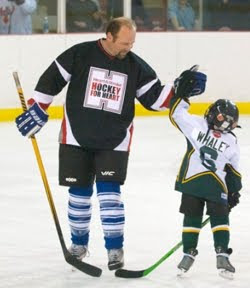
The Hockey for Heart tournament is the creation of Rob Weir. In 1993, Rob watched his father Roger die of a heart attack during a game of pickup hockey. Roger hadn't realized he had a heart condition. He was 46.
Rob launched Hockey for Heart in 1995 as a four-team tournament that raised $1,000 for the Heart and Stroke Foundation. Since then the tournament has expanded across Ontario and has raised over $890,000. Along the way, the tournament has had help from hockey royalty such as Johnny Bower (Roger's all-time favorite player), Darryl Sittler, Peter Zezel and Walter Gretzky.
Oh, and did I mention Wendel Clark?
Yes, Mr. All Heart himself is on board. He's been involved in the project for three years, and will be back this year for several tournaments.
This year's schedule begins in January and features stops in Toronto, Ottawa, Kingston, Hamilton and ten more cities.
Wendel Clark wants you to help out. You know what you have to do.
Here's how it works: Teams or individual players can register for their local tournament. Everyone gets three games (no contact, no slappers, just a rec-level fun time). Players raise money through sponsorships, and the top fund-raisers for each tourney get to take the ice for a special game against a team of pros and celebrities.
And yes, that means that you personally could wind up sharing a rink with Wendel Clark. If that opportunity doesn't get your attention, I'm not sure what you're doing on this site.
Puck Soup is a podcast featuring me and Ryan Lambert. We release one free episode each week during the season, plus mailbags and other bonus episodes for Patreon subscribers.
"Biscuits" was the Vice Sports hockey podcast, hosted by DGB and Dave Lozo. It ran for two seasons; the final episode was in July, 2018. You can find the archives below: