Showing posts with label ferguson. Show all posts

Wednesday, February 3, 2021

Puck Soup: Tony DeAngelo and other problems

In this week's episode of the Puck Soup podcast:
- Thoughts on Tony DeAngelo, where he'll wind up, and his alleged burner account
- COVID problems continue for the NHL and NWHL
- Tyler Toffoli continues to wreck the Canucks
- Connor McDavid and Leon Draisaitl are so fun
- Penguins GM candidates, including my thoughts on John Ferguson Jr.
- Which of the Golden Globe best picture nominees have I heard of?
- The return of the threesomes quiz
- And more...

>> Stream it now:

>> Or, listen on The Athletic or subscribe on iTunes.

>> Get weekly mailbags and special bonus episodes by supporting Puck Soup on Patreon for $5.


Tuesday, December 8, 2020

Which Leafs GM builds the best lineup of players they acquired?

The Leafs have a weird history of GMs. When it comes to handing over the keys to the franchise, some teams out there definitely have a type. But Toronto has always been all over the map. They’ve hired crusty old guys with decades of experience, but also fresh-faced kids with new ideas. They’ve pilfered other teams for recent Cup winners, but also promoted from within. They’ve had GMs who were really smart and successful, and others who… well, let’s just say some of these guys tried their best and had fun.

It’s an eclectic mix, to say the least. So today, let’s have some fun with that list, as we answer a question: Which Maple Leafs GM from the modern era can make the best six-man starting lineup out of players he acquired while in Toronto?

This won’t be a ranking of the best and worst GMs, at least directly. (If you’re interested, I took a run at that a few years ago.) Instead, we’re interested in who can offer up the best starting six of three forwards, two defensemen and a goalie. Acquiring a variety of good players isn’t quite the same thing as being a good GM, but there’s some obvious overlap, so we’ll get a sense for who did the best job while maybe uncovering a few surprises along the way.

But first, a few ground rules:

– GMs are getting credit for any player they acquired in any way. Not just trading, but free agency signings, waivers, and anything else. That includes the entry draft, and we’re giving GMs credit for any players the team picked while they were in charge. That’s admittedly a little dicey, since some GMs are more involved in draft table decisions than others, especially when they may have just taken the job and were probably just green-lighting the scouting staff’s picks. But the buck stops at the top, and this feels like the only fair way to do it.

– This is important: The GM is only getting credit for what the player did while they were a Maple Leaf. That can include production that came after the GM had left the job, but they don’t get credit for acquiring players who went on to make their names somewhere else. Call this the Tuukka Rask rule.

– For this post, we only care about who the GM acquired. We’re not worried about what they gave up, or whether they paid a fair price to do it. If you overpay to land a star player, that’s bad in real life, but for our purposes today, it works.

We’ll be covering the modern era, which is to say we’re going back to 1967, which marked the first big expansion and the end of the Original Six era. Something else may have happened in 1967 too but I’m sure it wasn’t important. We won’t be including Gord Stellick (who was only on the job for one season and would have trouble icing a full squad), Bill Watters (who was interim GM for just a few months in 1997), or the Mark Hunter/Kyle Dubas interim duo in 2015 (since we don’t know which one was calling the shots on individual moves). That leaves us with an even dozen GMs to consider, which is a nice number to work with.

Normally I’d do this chronologically, but I feel like we should just go ahead and start with the elephant in the room: Can anyone come close to beating Cliff Fletcher?

Team Cliff Fletcher (1991 – 1997, 2008)

Forwards: Doug Gilmour, Mats Sundin, Dave Andreychuk

Defense: Tomas Kaberle, Dmitry Yushkevich

Goalie: Grant Fuhr

Yeah, I’d say Team Cliff is pretty good.

Probably not surprisingly, it’s built almost entirely through trades. There was a reason they called him Trader Cliff, and I can remember a time growing up in Toronto where if you somebody ripped you off on something, you’d be told “Dude, you got Fletcher’d”. The man knew how to swing a blockbuster, back in an era where that was still a key skill for a GM to have.

There’s four Hall-of-Famers here, and you could make a reasonable argument that three of them did their best work in Toronto. Gilmour had the best short-term peak of any Toronto forward of the modern era, and Sundin is in the conversation for the best Leaf ever. It’s telling that Andreychuk’s back-to-back 50-goal seasons still leave him a distant third.

If there’s a weakness, it’s on the blueline, where I went with two long-term Leafs over Larry Murphy, who was better in Toronto than he gets credit for but isn’t fondly remembered. Jamie Macoun was an option here too. Still, Kaberle may be the best Leaf defenseman of the 2000s, so we’re in decent shape here.

Fun fact: Yushkevich was also the trade that spawned the infamous “draft schmaft” comment that’s a big part of Fletcher’s legacy in Toronto. And sure enough, there’s only one draft pick in this bunch, as Fletcher and the Leafs lucked into Kaberle in the eighth round in 1996 but otherwise didn’t find much.

Other candidates: Larry Murphy, Jamie Macoun, Sergei Berezin, Luke Schenn, Frederik Modin, Glenn Anderson, Mike Gartner, Kirk Muller, Jason Smith, Mikael Grabovski, Tie Domi, Alyn McCauley, Sylvain Lefebvre, Wendel Clark v2.0.

So yeah, this team is stacked. Are they unbeatable? Maybe, but let’s find out.

Team Brian Burke (2008 – 2013)

Forwards: Phil Kessel, Nazem Kadri, James van Riemsdyk

Defense: Morgan Rielly, Jake Gardiner

Goalie: Jean-Sebastien Giguere

Burke might be the second most memorable Leafs GM of the modern era, and if we were giving bonus points for sound bites he’d leave Fletcher in the dust.

As it stands, he still offers up a solid lineup. And maybe a little surprisingly, it’s one that’s strengthened by two excellent draft picks, as Kadri and Rielly were both legitimately strong choices. Combine that with Burke’s well-established reputation an as an aggressive and (usually) successful trader, and you’ve got the core of a strong entry.

Unfortunately, this team is very on-brand for Burke in two other ways: There’s no sign of a useful UFA signing, and the goaltending is weak. Giguere only lasted parts of two seasons, but our only other option is Jonas Gustavsson, and I think I’d take the Olaf Kolzig era over that.

Other candidates: Dion Phaneuf, Joffrey Lupul, Clarke MacArthur, Tyler Bozak

Team Burkie isn’t bad, but not quite at Team Cliff’s level. Let’s reach a little further back.

Team Gerry McNamara (1981 – 1988)

Forwards: Wendel Clark, Ed Olczyk, Gary Leeeman

Defense: Todd Gill, Al Iafrate

Goalie: Allan Bester

One of the most-maligned GMs in Toronto history puts together a surprisingly solid squad, one that’s built almost entirely through the draft. McNamara had his hands tied in free agency by the rules of the day and a cheapskate owner, and his trading record was pretty abysmal beyond the excellent deal to get Olczyk out of Chicago. But he hit on more than a few picks, even if he could never overcome Harold Ballard’s meddling long enough to build an actual winner.

Other candidates: Russ Courtnall, Vincent Damphousse, Stumpy Thomas, Luke Richardson, Ken Wregget, Motor City Smitty

Speaking of much-maligned GMs, let’s get this one out of the way…

>> Read the full post at The Athletic

(Want to read this post on The Athletic for free? Sign up for a free trial.)


Friday, December 28, 2018

Grab bag: Three stars of comedy HOF, Seattle GM power rankings, the Vegas outdoor game and more

In the Friday Grab Bag:
- The Three Stars of Comedy hall of fame class of 2019 is here, and it needs your vote
- A power ranking of the ten most entertaining choices for Seattle's new GM
- The NHL really needs to stop putting one player from every team in the all-star game
- An obscure player who's basically just there so I could make a bad Christmas pun
- And a YouTube look back at the modern NHL's original outdoor classic

>> Read the full post at The Athletic


Monday, November 26, 2018

A brief history of midseason GM changes (and how they’ve worked out)

The​ Philadelphia Flyers dropped a bomb​ on​ Monday,​ announcing​ that​ GM​ Ron Hextall​ had been fired​ midway through his​ fifth​ season on the​​ job. The move comes as a shock, partly because of Hextall’s long history with the franchise and partly because many figured that coach Dave Hakstol would be the first to go.

But there’s another reason the Hextall firing caught so many of us off guard: It’s extremely rare to see a team change its GM midway through a season. Putting a roster together is a big job, one that’s even harder to do when you don’t start until late November. Teams almost always prefer to let a new GM come in early in the offseason, with time to organize the front office, run the draft, and come up with a strategy for free agency and the salary cap. Changing coaches midway through a season often works out well, as we broke down last week. But GMs? That’s a whole different scenario.

Still, it does happen, including last season’s demotion of Ron Francis in Carolina. As we work through the fallout of the Hextall news, let’s take a look back at ten times in modern NHL history that a team has changed GMs during the regular season. This isn’t meant to be an exhaustive list, but we’ll try to pick out examples that demonstrate both the good and the bad of this sort of move.

2012-13 Columbus Blue Jackets

The old GM: One month into the lockout-shortened 2013 season, with the Blue Jackets having lost eight of their last ten, Columbus fired GM Scott Howson. The move came just months after he’d pulled off the biggest trade in franchise history, sending an unhappy Rick Nash to the Rangers.

The new GM: The team turned to Jarmo Kekalainen, making him the first European GM in NHL history.

How it worked out: Reasonably well, even as some observers thought Howson got a raw deal. (He memorably received two votes in GM of the Year balloting despite being unemployed.) Kekalainen remains on the job to this day – along with Bob Murray of the Ducks*, he’s the only current GM who was a midseason hire – and has built the Blue Jackets into Cup contenders.

2000-01 Boston Bruins

The old GM: We may never see another GM like Harry Sinden, who’d been on the job for 28 years when he finally stepped down in November 2000. He remained on as president, a role he’d hold until 2006, but the Bruins would have a new GM for the first time since the days of Bobby Orr and Phil Esposito.

The new GM: Mike O’Connell took on the dubious job of replacing a franchise icon.

How it worked out: The Bruins were well into rebuilding mode – this move came a few months after they’d traded Ray Bourque to the Avalanche – but O’Connell got them back to the playoffs by 2002, winning the Northeast Division in the process. But he never won a playoff round and was fired at the end of the 2005-06 season. Fairly or not, he’s probably best remembered for being the only GM in North American pro sports history to trade a player in the middle of a season in which he won MVP.

2013-14 Buffalo Sabres

The old GM: Darcy Regier, who’d been on the job since 1997 and had led the team to the Stanley Cup final in 1999. But after a 4-15-1 start and with Buffalo fans chanting “Fire Darcy” at home games, a move seemed inevitable. It was.

The new GM: This is where things get a bit weird. The Sabres didn’t immediately name a new GM, but did appoint Pat LaFontaine as the president of hockey operations and Regier’s de facto replacement. LaFontaine eventually hired Tim Murray away from the Senators in January, in a move that was widely applauded. But by March LaFontaine was gone too, resigning amid reports of an “ugly” conflict with Murray over player personnel decisions.

How it worked out: Murray initially seemed like a great hire; he did well on the Ryan Miller trade, and did the dirty work to prepare the Sabres for the 2014-15 tank job that landed them Jack Eichel. But he couldn’t turn the team around once they’d hit rock bottom and was fired as part of yet another Sabres housecleaning in 2017.

>> Read the full post at The Athletic


Tuesday, May 15, 2018

Ranking every GM the Maple Leafs have ever had

The Toronto Maple Leafs made it official on Friday, naming Kyle Dubas as Lou Lamoriello’s replacement as general manager. It’s a major leap of faith by the team, with the fate of the 101-year-old franchise now in the hands of a GM who’s just 32 years old.

We can’t pass a final judgement on the Dubas era quite yet — we’ll give him about one more week before we get started on that. But in the meantime, we can see how the other men to hold the job stack up with each other.

We’ll be looking at all of the full-time GMs in Maple Leafs history — we won’t count any interim tags, or the time that the team went without an official GM for a little over a year. That leaves us with 16 pre-Dubas GMs to work with, which seems like a good number for a ranking. Let’s count them down from worst to best, starting with the least-effective Leafs’ GM of all-time. As you might expect, there was some decent competition for that particular honour.

No. 16: Howie Meeker (1957)

Record: Not applicable.

Signature move: None.

There could be some debate over whether Meeker even deserves a spot on this list; after all, he didn’t even make it to his first game as Maple Leafs’ GM before he was “reassigned” to the PR department. But he did officially hold the role, however briefly, so we’ll include him.

Meeker had had a distinguished career in Toronto, including winning the Calder in 1947 and spending a season behind the bench in 1956–57. That year hadn’t gone that well, with the Maple Leafs missing the playoffs, and Meeker was bumped upstairs to the GM job once the season ended. But it didn’t last, and Meeker was out of the role before opening night. News reports of the day called it a resignation, but Stafford Smythe left little doubt as to what was really going on, telling reporters that “[Meeker] didn’t have the experience needed in that kind of job and we didn’t have the time to let him gain that kind of experience.”

The Leafs didn’t formally fill the GM’s role until over a year later, going with a committee approach (although Smythe was rumoured to be calling most of the shots).

No. 15: Floyd Smith (1989–1991)

Record: 61-84-5

Signature move: Trading a first-round pick for Tom Kurvers.

The Leafs finished .500 in Smith’s debut season, the first time that happened since 1978–79. But his second year was a disaster, one that saw an aging Leafs team start 1-9-1 and very nearly finish dead last. They rallied to finish ahead of the Nordiques, meaning the Kurvers trade cost them Scott Niedermayer instead of Eric Lindros, and Smith was fired after two years on the job.

To give you a sense of how the Smith era played out in Toronto, here’s local sportscaster Joe Tilley not mincing words.

No. 14: Hap Day (1955–1957)

Record: 45-67-28

Signature move: None stand out; the few Leafs traded during this time basically amounted to selling fringe players for cash.

There’s some confusion as to whether Day ever officially held the GM’s title, but everyone seems to agree that he was running the show at the end of the Conn Smythe era, so we’ll include him. The team made one playoff appearance in Day’s two seasons, but after missing in 1957 he was publicly criticized by the Smythe family and forced out, ending a Maple Leafs career that saw him win seven Stanley Cups as a player and coach.

>> Read the full post at Sportsnet


Friday, February 24, 2017

Ranking every Maple Leafs trade deadline of the last 25 years

The trade deadline is less than two weeks away, and most of the speculation has the Maple Leafs being relatively quiet. They’ll probably make a depth move or two, and could deal a pending UFA, but anything bigger than that would come as a surprise.

That’s likely the right move for the franchise, even if it would no doubt draw criticism from some fans who want to see the team swing for the fences. Trade deadlines are always more fun when your team goes big.

Then again, big deals aren’t always the best deals, and Leaf fans know that well. The team has had, to put it generously, a mixed history when it comes to the trade deadline. Today, let’s revisit that history with a quick ranking of every Leafs trade deadline of the last 25 seasons.

We’ll define “the deadline” as the two weeks leading up to the last day of trading, and our 25-season cutoff will take us back to 1991. Why then? Because 25 is a workable number, it essentially covers the time where the NHL’s trade deadline was a big deal, and it happens to coincide with the start of the Cliff Fletcher era. Also, it avoids having to mention the Harold Ballard era, as per my therapist’s recommendations.

We’ll rank our way down from worst to best. And we’ll start with one of the low points in recent franchise history.

25. – 2008

The deals: On the verge of missing the playoffs for a then franchise-record third straight year, the Leafs fire John Ferguson Jr. and head to the deadline firmly in fire-sale mode. Interim general manager Cliff Fletcher moves Wade Belak, Chad Kilger and Hal Gill, all for picks.

The outcome: None of the picks end up helping the Leafs, but that’s not the reason this year rates dead last on our list. No, that has more to do with who wasn’t traded – namely, the fabled Muskoka Five, the group of veterans led by Mats Sundin who decide en masse not to waive their no-trade clauses.

Fletcher is clearly furious, but his hands are tied. A golden opportunity to rebuild slips away – Tomas Kaberle would have landed the Leafs a young Jeff Carter – and the team doesn’t fully recover for years.

24. – 1997

The deals: With the Leafs on the verge of missing the playoffs for the first time in five years, Fletcher goes into sell mode. He’d already moved Doug Gilmour to the Devils a month earlier. On deadline day he sends Kirk Muller to the Panthers for prospect Jason Podollan, and Larry Murphy to the Red Wings for future considerations.

The outcome: Podollan never amounts to anything. But it’s the Murphy deal that stands out. The future considerations end up being nothing at all – Fletcher literally hands a future Hall-of-Famer over to the Red Wings as a freebie. Murphy puts in four good years in Detroit, helping them win two Cups, and the move stands as one of the most lopsided trade deadline deals in league history.

23. – 2003

The deals: In what turns out to be his last year as general manager, Pat Quinn goes all-in. He makes the Owen Nolan blockbuster, and trades draft picks for veterans Glen Wesley, Phil Housley and a returning Doug Gilmour.

The outcome: You can appreciate the effort, but in hindsight none of the moves work. Nolan gets hurt and later has a falling out with the franchise, and acquiring him costs the Leafs a first-round pick in the ridiculously stacked 2003 draft. Wesley and Housley don’t add much. And the worst of the bunch is Gilmour; his big return lasts just five shifts before his career ends on this play:

22. – 2001

The deals: In their only deadline deal, the contending Leafs trade Adam Mair and a second-round pick to the Kings for Aki Berg.

The outcome: Berg struggles badly and quickly becomes a whipping boy in Toronto. The deal somehow gets even worse when the Kings turn the second-round pick into Mike Cammalleri.

21. – 1996

The deals: With Pat Burns fired and the Leafs fading, Fletcher starts blowing things up by sending Ken Baumgartner to the Ducks and Dave Andreychuk to the Devils. But the big news is the blockbuster that brings Wendel Clark back to Toronto.

The outcome: The Clark trade ends up being widely viewed as a disaster; the Leafs give up a young Kenny Jonsson and a 1997 draft pick that turns into Roberto Luongo. It’s the deal that leads to Fletcher’s infamous “draft schmaft” comment and puts the first serious dent in his Toronto reputation. Still, if you were a Leafs fan back then, you can’t deny that Clark’s return to the Gardens was one of the decade’s best moments.

20. – 2013

The deals: In the first year of the Dave Nonis era, the Leafs only make one move, adding Ryan O’Byrne for a pick.

The outcome: You would have thought the playoff-bound Leafs would be trading for multiple assets, but as it turns out, it was for one.

>> Read the full post at TheAthletic


Tuesday, February 17, 2015

The NHL's greatest almost-happened blockbusters

With less than two weeks to go until the trade deadline and one blockbuster already in the books, hockey fans will spend the days until March 2 dreaming of monster deals that will shake teams to their foundation.

We probably won’t get any, but we can still hope. Trades are great fun, even though they’re largely a dying art in today’s NHL. And maybe even more fun than the completed deals are the near misses, the blockbusters that almost happened and then, for whatever reason, fell apart. We don’t always hear about those, but when we do, it can be great entertainment to look back at them years later and shake our heads at what could have been.

One big caveat: Since none of these deals were actually consummated, and NHL front-office types aren’t exactly in the habit of going on the record about this stuff, we’ll never know for sure how close any of these moves actually came to happening. All the deals below are rumors — well-reported rumors several steps above the usual message-board nonsense — but rumors nonetheless. Please have a large grain of salt or two handy before reading further.

With that out of the way, here are five huge trades1 from NHL history that (allegedly) almost happened, but didn’t.

Detroit trades Steve Yzerman to Ottawa for Alexei Yashin

Today, Steve Yzerman is a Red Wings legend, and the idea of him ever taking the ice in any other team’s uniform seems unimaginable. But as we’ve covered before, there was a time when Yzerman seemed to have worn out his welcome in Detroit. He was a great player, but he just wasn’t a winner, the thinking went, and it was time for the franchise to turn the page and move on. In 1995, the Red Wings almost did just that.

They found a willing trade partner in Yzerman’s hometown team, the Ottawa Senators. The deal would have reportedly centered around young center Alexei Yashin, and while they’d no doubt deny it now, plenty of Red Wing fans thought it sounded like a fantastic idea. One rumor at the time said the deal was actually agreed to, and fell apart only when Detroit ownership stepped in at the last minute and nixed it.

Yzerman went on to captain the Red Wings to three Stanley Cups, while Yashin’s endless holdouts eventually made him one of the most hated players in Senators history. (Luckily for Ottawa, they eventually found a sucker to take him off their hands.) Today, the idea that a team would want to address a of a winning culture by trading Steve Yzerman for Alexei Yashin seems almost too ridiculous to comprehend. But at one point, Detroit came very close to doing exactly that.

Come on, Red Wings. If you have a choice between the Russian embroiled in a contract dispute and the good North American boy, you’d be crazy to choose the Russian!

Detroit trades Pavel Datsyuk to New Jersey for Scott Gomez

Hm. OK, scratch that last thought.

>> Read the full post on Grantland


Monday, December 16, 2013

Brian Burke interviews candidates for the Flames' GM job: The top secret transcript


Scene: Brian Burke's office at the Calgary Flames headquarters. Burke sits behind a large desk across from a single empty chair. Behind him, special assistant Craig Conroy is consulting a clipboard.

Conroy: OK Brian. I did what you asked, and arranged for the very best GM candidates from around the league to meet with you today. We've got a pretty full schedule, so we should probably get started.

Burke: Sounds good. I'm ready.

Conroy: OK, so our first candidate is the one everyone's talking about. Former Flames' superstar, already has GM experience, and he's worked with you in the past.

Burke: Sounds just about perfect. Bring him in.

(Joe Nieuwendyk walks into the room and takes a seat.)

Burke: Welcome, Joe, and thanks for meeting with me.

Nieuwendyk: More than happy to. Thanks for the invite.

Burke: So you're obviously a great fit for this job, but I'd like to hear a little bit about what your plan would be if we do hire you. Tell me, what would be the first thing you'd do if you were the next GM of the Calgary Flames?

Nieuwendyk: I'd be looking to acquire a franchise player. Somebody to build the organization around for the next decade. The next Jarome Iginla, so to speak.

Burke: Sounds great. And you'd acquire him by…

Nieuwendyk: … trading myself for him.

Burke: I see.

Nieuwendyk: Maybe throw in a third-liner to get the deal done. You know how it is.

Burke: I think there may be a slight flaw in your plan, Joe.

Nieuwendyk: Hey, do you know any other way to acquire a guy like Jarome Iginla?

Burke: Well…

Conroy (helpfully): You could kick his butt so badly in the playoffs that he begs you to let him join your team!

Burke: …

Nieuwendyk: (glances over at a copy of the standings)

Conroy: Oh, right. Trading it is, then.

Burke: Thanks Joe. We'll be sure to let you know. Craig, who's next?

Conroy: Our next candidate is an experienced GM who says he's worked with you in Toronto and Vancouver.

Burke: Really? Who?

(Dave Nonis enters the room.)


Tuesday, September 4, 2012

Team Canada's 1972 Summit Series application form

While hockey fans may have missed it among all the lockout doom and gloom, Sunday was an important anniversary in hockey history. The day marked forty years since Canada and the USSR took to the ice at the Montreal Forum for game one of their infamous 1972 Summit Series.

Most Canadians know the story of the series by heart. But did you know how the team was put together? Hockey historians recently unearthed the original application form that was sent to Canadian players, and DGB spies were able to send me a copy.

***

Thank you for your interest in playing for Team Canada in the 1972 Summit Series. To help us narrow down the list of candidates, please fill out the application form below.

Your name: _______________________
Your position: ________________________
NHL team that you play for: _______________
(If you wrote “Montreal Canadiens”, skip the rest of the form; you’ve made the team!)

What was your first thought after series organizer Alan Eagleson initially approached you about participating?
( ) “It would be an honor to represent my country.”
( ) “This sounds like a once-in-a-lifetime opportunity.”
( ) “It will be interesting to travel all the way to Russia.”
( ) “Hey, that’s weird, my wallet is missing.”

What is your primary reason for wanting to join Team Canada for the Summit Series?
( ) Have always admired the passion of Canadian hockey fans, and think it would be fun to be booed mercilessly by them the first time we have a bad shift.
( ) Will be a nice change of pace from the typical 1970s player’s pre-season preparation of trying really hard not to chain-smoke quite as much while grilling ribeye steaks three meals a day.
( ) Hoping assistant coach John Ferguson brings his adorable five-year-old son to the practices, since it’s so cute how he falls for the “trade me two dimes for a nickel” trick every single time.
( ) Honestly, just want to be close to Phil Esposito’s sideburns.


Tuesday, February 14, 2012

Take the quiz: Should you waive your NTC?

"Yes, I will waive my no-trade clause,"
said Rick Nash, immediately, every
time he answered his phone.
Mats Sundin had his number raised to the rafters by the Toronto Maple Leafs on Saturday. But while the honor naturally lead to plenty of warm memories, it also stirred up some old debates about the nature of loyalty in modern sports.

Sundin’s infamous decision not to waive his no-trade clause in 2008 helped write a controversial final chapter on an otherwise brilliant career in Toronto. To this day, many fans feel he made a selfish choice that hurt the team, while others argue that his only sin was being too loyal to a franchise that didn’t deserve it.

With the trade deadline just two weeks away, plenty of players can expect to find themselves in Sundin’s shoes in the coming days. The no-trade clause dilemma is no easier today than it was four years ago: Do you waive your rights and accept a deal, or stand your ground?

It’s a tough call. So if you’re an NHL player who finds himself wondering what to do with your own no-trade clause, this simple quiz might help:

While it’s natural to be concerned around trade deadline time, relatively few players are actually dealt each year. What makes you think you’re about to be traded?
a.) Have been personally told by my general manager that several teams are very interested in acquiring me.
b.) Have seen my name mentioned in speculation by well-established media insiders.
c.) A big-time hockey rumor blogger started telling me that all his super-connected sources are talking about me, before his manager started yelling at him that the deep fryer wasn’t going to just work itself.
d.) Had over two dozen scouts watching me in person last night, which was odd since we didn’t have a game and I was just eating dinner in my kitchen.

Many of today’s no-trade clauses have loopholes or are otherwise limited in some way. Does this apply in your case?
a.) My no-trade clause is complete and covers me in all circumstances
b.) If my team misses the playoffs a window opens up, in the sense that the team can trade me without my consent during the offseason.
c.) If my team misses the playoffs a window opens up, in the sense that that’s what the GM and coach will be throwing my overpaid carcass out of.
d.) I can provide a list of teams I do not wanted to be traded to each year, if frantically writing “Edmonton” over and over in increasingly larger letters on a sheet of loose leaf paper can actually be considered a “list”.


Saturday, December 17, 2011

A brief history of Teemu Selanne

NHL scoring dropped dramatically after
the league outlawed the lens flare stick.
Teemu Selanne will be wearing an away jersey tonight in Winnipeg, but he won't be hearing many boos. In fact, Jets fans are likely to give him a hero's welcome.

It's been over 15 years since Selanne last played an game in Winnipeg, but fans there haven't forgotten the magic moments he created as a Jet in the early 90s. Once the NHL announced the return of a franchise to Winnipeg, fans circled tonight's game on their calendar for what's sure to be an emotional reunion.

So as Winnipeg prepares to give Selanne a long-awaited ovation, let's take a look back at the career of one of hockey's most beloved superstars.

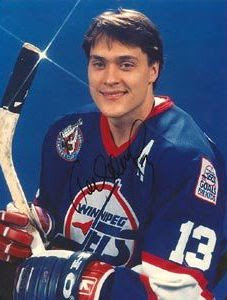
June 11, 1988 - Selanne is drafted with the 10th overall pick by Winnipeg Jets general manager John Ferguson Sr., who must then explain to his confused son why he's not immediately trading him for a terrible backup goalie.

October 8, 1992 - Veteran Jets defenceman Randy Carlyle refuses Selanne's request for his jersey number 8, then wonders why the rookie is walking away mumbling something about "payback" and "revenge" and "Bruce Boudreau in 20 years".

March 2, 1993 - Selanne breaks Mike Bossy's rookie goal-scoring record and then famously mimes shooting his glove out of the air, while a young Artem Anisimov watching at home imagines how everyone would probably think it was really cool if he did something like that too someday.